
A while back I wrote about the capabilities of Pro Power Onboard and how it was changing the way I worked. One of the biggest challenges in mobile coffee has always been power.
It sounds simple enough until you start looking at what coffee equipment actually demands.

Commercial espresso machines pull serious power. Running them from traditional leisure batteries has always been close to impossible for any meaningful amount of time. Generators are an option, but they bring their own challenges: they're noisy, expensive to run, need constant maintenance and fuel, and if we're honest, they're not exactly great for the environment either.
Mains power has been our solution for years and it has worked brilliantly, but it also puts boundaries around where we can go and what we can do. And we really don't like boundaries.
Over the last year, we've already used Pro Power Onboard at a handful of off-grid events to run our coffee vans. We'd seen what it could do first-hand and knew there was something exciting there.
So when we got a call back in January asking if we'd be interested in converting one of Ford's new Ranger PHEVs1 into a coffee truck, there wasn't even a discussion. We literally jumped at the opportunity.
Because imagine that for a second: an off-grid, off-road coffee truck. Absolutely.

Straight away the ideas started flying around. We found ourselves sketching layouts and imagining how everything would fit into the truck bed. How would we split the power effectively across the sockets? What would workflow look like when serving? How could we make it practical while still keeping it compact?
But more importantly, where would we take it?
My mind instantly jumped to a coffee setup perched high up in the Alps somewhere, serving espresso with mountain views stretching for miles. No cables, no generator humming away in the background, just incredible coffee in incredible places. That was the dream.
Then Wilbur arrived. Yes, all our vehicles have to have names. And from the moment he landed, we got to work. Within about a week, Wilbur had been transformed. Custom pull-out drawers were built, electrics installed, water tanks filled, an espresso machine bolted securely into place and an awning attached.

“No cables, no generator humming away in the background, just incredible coffee in incredible places. That was the dream.”Amy McMillan, founder and owner of the Coffee Can Company
Suddenly, this idea we'd been talking about was sitting right in front of us. Our first true off-grid coffee rig. And honestly? We're obsessed.
Wilbur has already been busy this year too. He's attended open days, hospital staff wellbeing mornings, multiple driving experience days and some fantastic events for Ford themselves. One of the highlights had to be supporting the launch of the new Ford Mustang GTD alongside the Mustang Owners Club.
The thing we've realised very quickly is just how much freedom this setup gives us. We can genuinely take it almost anywhere. It's opened doors to events that previously would have been impossible because of power limitations. Places we'd have reluctantly had to turn down before are suddenly on the table.


The whole thing looks incredible too. Everywhere it goes, people stop, stare and start asking questions. And then they see it actually working. That's when the conversations really start.
The power capabilities still amaze us. No dodgy extension leads. No worrying about power surges. No overheating cables. We can even leave the coffee machine heating up while we're driving to an event, which sounds like a small thing until you've worked in coffee.
Usually arriving at an event means unloading, setting up and then waiting while everything comes up to temperature. Now? We turn up ready to rumble.
Even when the engine occasionally kicks in to top the batteries up, it's barely noticeable. Just a quiet rumble in the background that almost makes you stop and appreciate what's happening. Because you're standing there, in the middle of nowhere, completely off-grid, making incredible coffee. And it still feels a bit surreal.
We've run multiple days in a row while only using around half a tank of fuel. Heating two large espresso machine boilers simultaneously is something people still struggle to believe until they see it for themselves.
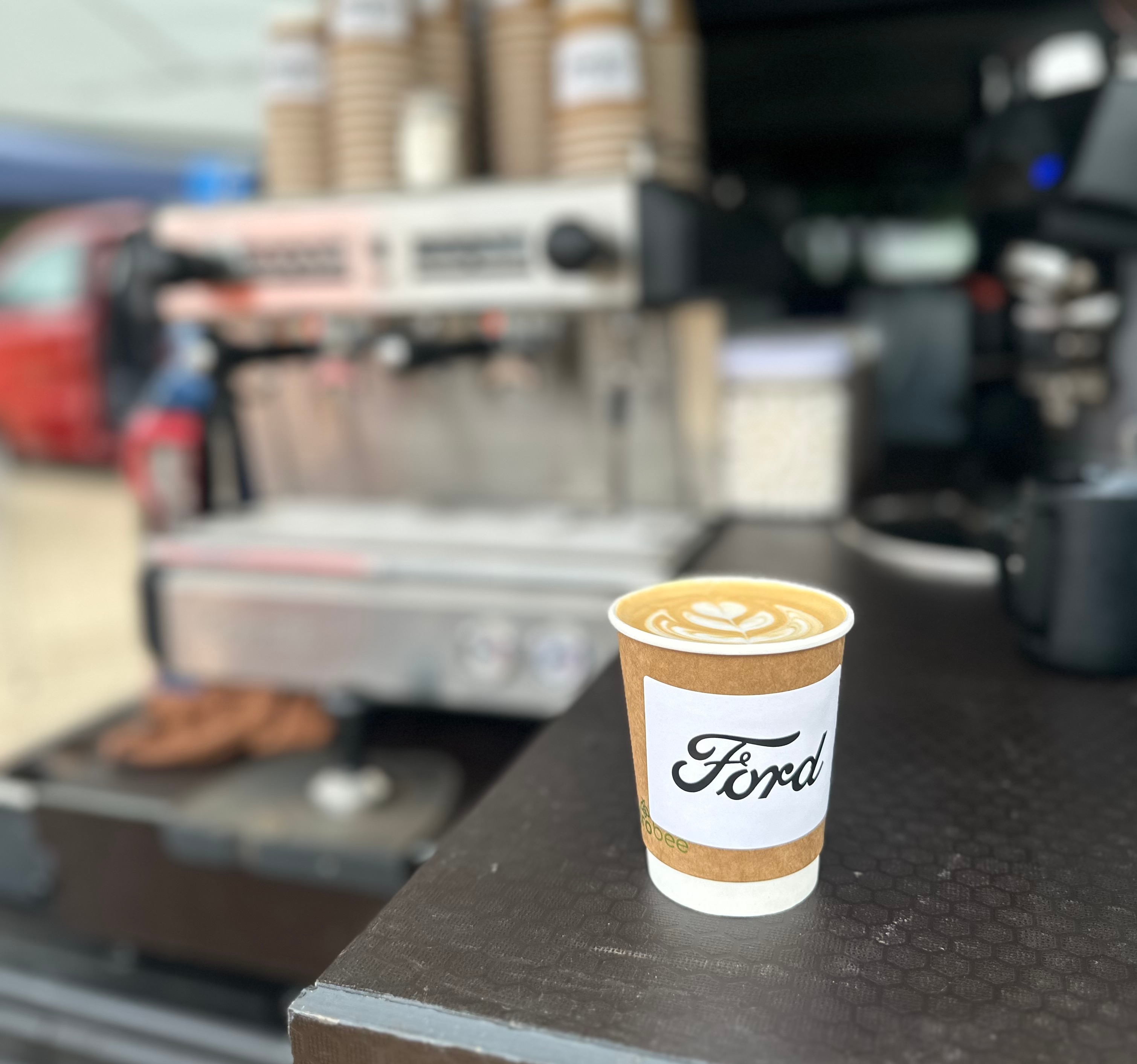
Then there's the knock-on effect too. No more generators. No more hiring trailers. No more fuel runs because a generator is burning through petrol all day. No more building an entire event around power limitations.
In fact, a few weeks ago, we turned up to an event and discovered another food trader hadn't been told there was no power available on site. We unplugged our boiler and plugged them straight into the truck instead.
So suddenly there we were: our coffee setup and an entire food truck, both powered by Ford.

Moments like that really make you stop and think about how much things are changing. We haven't made it to the Alps just yet. But the year's still young.
Amy McMillan is founder and owner of the Coffee Can Company

1 Ford Ranger Plug-In Hybrid homologated CO2 emissions 143-145 g/km WLTP Euro 6e-bis (UK: 70-72 g/km Euro 6e), homologated fuel efficiency 6.2-6.4 l/100 km WLTP Euro 6e-bis (UK: 3.1-3.2 l/100 km Euro 6e) and pure electric driving range up to 43 km WLTP. The declared WLTP fuel/energy consumptions, CO2 emissions and electric range are determined according to the technical requirements and specifications of the European Regulations (EC) 715/2007 and (EU) 2017/1151 as last amended. The applied standard test procedures enable comparison between different vehicle types and different manufacturers. A range of up to 43 km can be achieved with a fully charged battery - depending on the existing series and battery configuration. The actual range may vary due to various factors (e.g. weather conditions, driving style, route profile, vehicle condition, age and condition of the lithium-ion battery)