

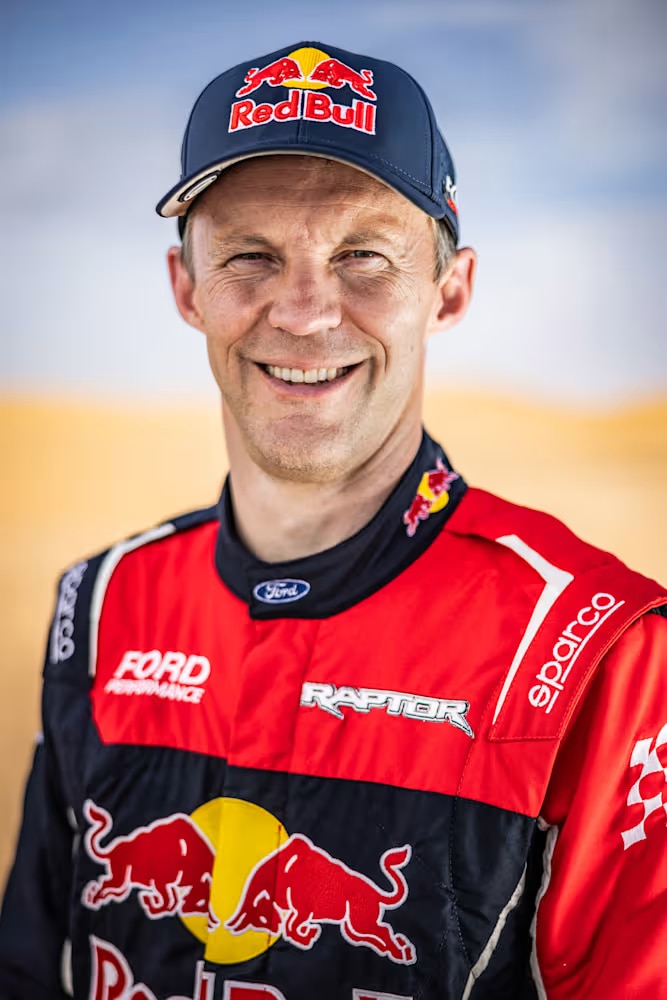
Nothing can compare to the excitement of driving a car in competition. I’ve been racing since I was 15 years old, but I still get a thrill from the challenge of pushing a car, and myself, to the limit.
Most racing drivers want to be in F1, but I always wanted to be the most versatile “real car” driver, which is why I’ve competed in Dakar, DTM, WRC and rallycross.
For me, the most important thing is the car’s fundamentals. As a driver, I want to feel the car — it needs to respond to my inputs, and communicate what is happening back to me. This constant feedback loop is essential for you to feel at one with the car, like a hand in a glove.
F1 cars might be mid-engined, but if you’re driving a road car on track, you can’t beat the classic front-engine, rear-wheel-drive setup. It gives you a good, neutral balance without too much understeer or oversteer. If a car handles well, I get a lot of satisfaction even when driving slowly from a car that does what I want. You don’t have to go fast to have fun. When a car does what you ask of it, you don’t have to worry about looking like a rookie.


And while we’re making a wish list, if I were to choose any engine up front, it would have to be a roaring V8. It’s a classic design that’s been going strong for over 120 years, and with good reason. An unmistakable sound, strong low-down torque combined with top-end firepower means you’re never short of punch, and it’s always ready to respond to your inputs. The V8 has been a part of Mustang’s 1 history from the very beginning, all the way to today’s GT, Dark Horse and GTD. 2
It’s also important to recognise Ford’s rich motorsport history, and how it feeds into its road cars. Few manufacturers have competed in so many disciplines — F1, NASCAR, IndyCar, WRC, Rally Raid, saloon racing, rallycross — and been so successful. And the drive for improvement on the track, making every fraction of a second count, means better road cars that are born out of the white heat of competition.
So here we are at the Salzburgring in Austria, with the keys to an 826 PS Mustang GTD and a clear track ahead. What’s the secret to being quick as well as staying in control?
The Mustang GTD has all the right attributes for the demands of the track — engaging Track mode gives us sharper throttle response while the stability and traction control are reduced, giving us more freedom but with a safety net, just in case. The semi-active suspension is also lowered and stiffened up, which is exactly what we want on track.
Whatever the shape or radius of a corner, it can be broken down into three key points; turn-in, apex and exit. By the time you reach turn-in, you should have finished braking — or at least be rolling off the brakes as you turn the wheel. This keeps the weight towards the front wheels where you need the most grip.
As you aim for the apex — effectively the halfway point of the corner — you need a balanced throttle to keep the car balanced too, maintaining its speed until you start to exit. It’s tempting to accelerate early to give you more speed down the next straight but do this too early and you’ll need to back off again. Getting the timing of your acceleration right is crucial.
As you head for the exit and begin to accelerate, quick but progressive acceleration is key. Push too hard and the rear wheels will start to slide — definitely fun, but not the fastest way. Get it right and you can be at full throttle as you exit, straightening the wheel to open out the turn and let the wheels devote all the available grip to pushing you on.

That’s just the very basics, and there are so many nuances beyond this, never mind the fact that every corner on every circuit is different, with its own quirks and nuances even before you take into account the track condition and weather.
It’s this endless variation that makes every corner of every lap an adventure — the pure challenge of getting through as quickly and cleanly as you can. Tracks like the Salzburgring have this variety of corners to really challenge you and the car, a challenge that the Mustang GTD handles brilliantly.
I’ve probably completed thousands of laps of dozens of circuits around the world in my career, and it still gives me a buzz that can’t be beaten. It’s just you and your machine against the track and the stopwatch.
Mattias Ekström is a Ford M-Sport driver, two-time Dakar podium finisher, two-time former DTM champion, four-time winner of Race of Champions and former FIA World Rallycross champion






Closed course. Professional driver. Do not attempt. Track capability is dependent on environmental conditions, track conditions, and driver inputs. Always consult owner’s manual and drive within your and the vehicle’s capability limits.
1 Mustang homologated CO2 emissions 273-282 g/km and homologated fuel efficiency 12.0-12.4 l/100 km WLTP.
2 Mustang GTD homologated CO2 emissions 349 g/km and homologated fuel efficiency 15.3 l/100 km WLTP. The declared WLTP fuel/energy consumptions and CO2-emissions are determined according to the technical requirements and specifications of the European Regulations (EC) 715/2007 and (EU) 2017/1151 as last amended. The applied standard test procedures enable comparison between different vehicle types and different manufacturers.
