
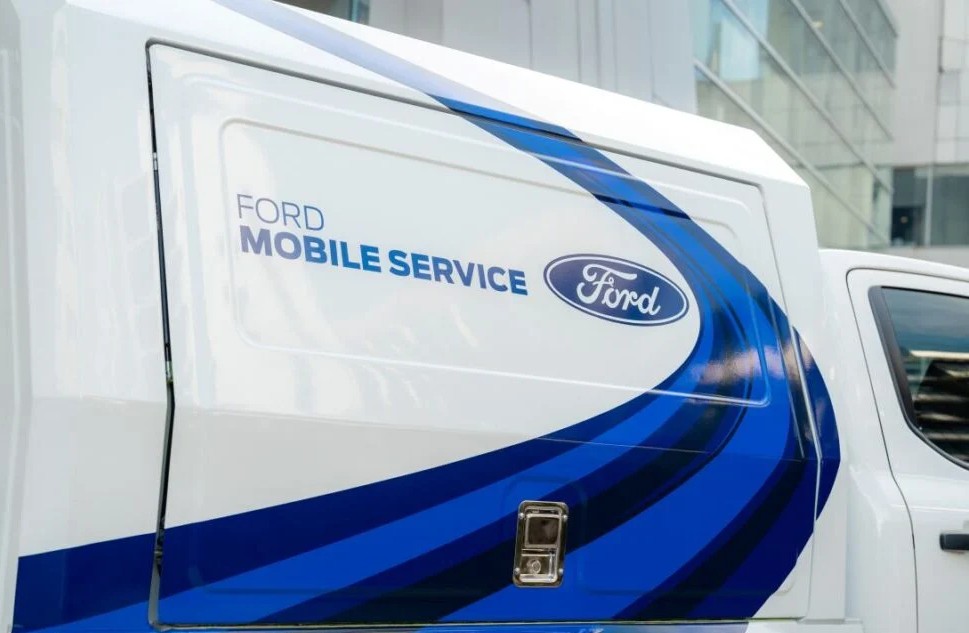

It was a Friday morning and a driver for a Queensland utility provider was midway through his run when his Ford Ranger flagged an alert: a change in engine performance that needed attention. In the past, that would have meant packing it in for the day. Driving the vehicle to a dealership, sorting a lift back, and potentially losing hours of productivity.
Instead, the driver called his coordinator and returned to the depot. By 10:23 am, Pacific Ford in Maroochydore had been notified. By 1 pm, a Ford mobile service technician pulled into the depot in a custom-built Ford Ranger service vehicle. Thirty minutes later, the fix was done: a loose clamp on the boost pipe, nothing to replace. The Ford dealer tech tightened it then and there.
Total vehicle downtime: 3 hours and 7 minutes. Back in service the same afternoon.
Stories like this are exactly why we are piloting mobile service in Australia, and why it's only one part of a much bigger shift underway with Ford ProTM.
Why commercial uptime matters more than people think
Commercial vehicles are the backbone of Australian business. They're how tradies get to the job, how goods move and how the essential economy keeps running. Water utilities, energy providers, logistics operators: the people and businesses that Australians rely on every day. Ford's job is simple: when these businesses grow, we grow.
When you spend time with fleet operators across this country like I do, one thing becomes impossible to ignore: distance costs them money. Not just fuel or wear and tear, but the hours lost when a commercial vehicle needs servicing and the nearest dealership is a long drive away. A vehicle off the road isn't just an inconvenience. It's lost income, missed jobs and reputational damage that can cost a small operator their next customer.
So we kept asking ourselves: how do we service these customers better, more remotely, more efficiently? Mobile service units are the newest answer to that question, designed to meet customers where the work happens.
Proven in Europe, rebuilt for Australia
The concept wasn't unproven when we started. Fleet customers in Europe using mobile servicing report satisfaction scores up to 20 percentage points higher than those relying on traditional workshops alone. But Australia's challenge is different: our fleet customers are often hundreds of kilometres from the nearest dealership, and our distances and conditions can be extreme, so we adapted the principle rather than importing it wholesale.
Designing a workshop to be carried by a Ranger
We went to one of our certified Ford ProTM Convertors and worked with them to design a purpose-built service body for the back of a standard Ford Ranger, not an off-the-shelf solution. We developed it specifically to perform maintenance and light repairs out in the field.
They performed conversions on the vehicles to the exact same specifications: same tool layout, same capability, same quality. We shipped them to selected Ford dealerships across the country at no cost to the dealers, so they could test them in real-world conditions and see the value for themselves.
Each unit is equipped to handle the type of work that keeps a fleet moving without a trip to the workshop: minor scheduled servicing, eligible field service actions and software updates that can't be done over the air, oil condition checks, and light mechanical repairs – all performed on-site.
Where the units are working today
We currently have mobile service Rangers, available at limited dealers only deployed across a deliberate mix of regional and metropolitan sites. In regional Queensland, it's about reaching customers sometimes over 300 kilometres from the nearest workshop, including operators in remote, harsh conditions where a fixed service site visit isn't practical, and once they experience it, many have told us they prefer it to a workshop visit altogether.
In metro areas like Melbourne and Brisbane, it's about convenience, servicing fleet vehicles on-site to help drivers from losing a day. And for situations like the water utility's Friday morning surprise, it's rapid response, minimising downtime when something unexpected happens.
What are people are saying about Ford Pro’s mobile servicing?
The feedback has been the best part, it tells us we're genuinely solving problem fleets experience every day.
A mining industrial equipment manufacturer in Queensland that runs a fleet of more than 40 Rangers booked eight mobile service visits by Mackay City Ford in just six months. They said of their experience: "The mobile service Ranger has been very useful in reducing lead times and fleet vehicle movement, especially for smaller diagnosis. It's always on time and efficient." With this customer, several visits meant the vehicle was out of action for as little as 20 minutes, and today, a growing share of its servicing needs is handled without a single vehicle leaving its depot.
The customer experience manager at Mackay City Ford told us that mobile service has been a fantastic step forward, enabling them to deal with issues quickly and easily. A business owner once kept her on the phone for nearly 15 minutes just giving positive feedback.
Ford ProTM more than a truck with tools in the back
Mobile service doesn't stand alone. It's the newest layer of a service and support network that Ford is continuing to grow across Australia: 220 service outlets, 18 Ford ProTM Convertors across 52 locations nationally, nationwide parts distribution, roadside assistance and subscription-based connected vehicle uptime tracking on Ranger and Everest that can give customers and technicians visibility of a vehicle's health before it becomes a problem.
Historically, a fleet operator chasing uptime had to piece it together themselves: the right vehicle from one place, financing from another, upfits from a third, fleet software from a fourth. Ford ProTM is trying to change that by bringing vehicles, customisation, financing, service and software under one umbrella. The goal isn't complicated: help commercial customers spend less time managing their fleets and more time running their businesses.
Mobile service is a clear expression of that thinking in action today. It's proof that Ford isn't just making great trucks and vans. It's developing the infrastructure, the data and the service model to keep them working, wherever a customer's job takes them.
And it's a preview of where this is heading. Subscription-based connected vehicle data will continue to develop becoming a more helpful tool for fleet managers. Picture a technician pulling into a depot shortly after the driver becomes aware something needs attention, fix done before lunch, no disruption. That's the future we're working toward.
That Queensland driver finished his Friday on the road, not in a waiting room. That's the point.
