
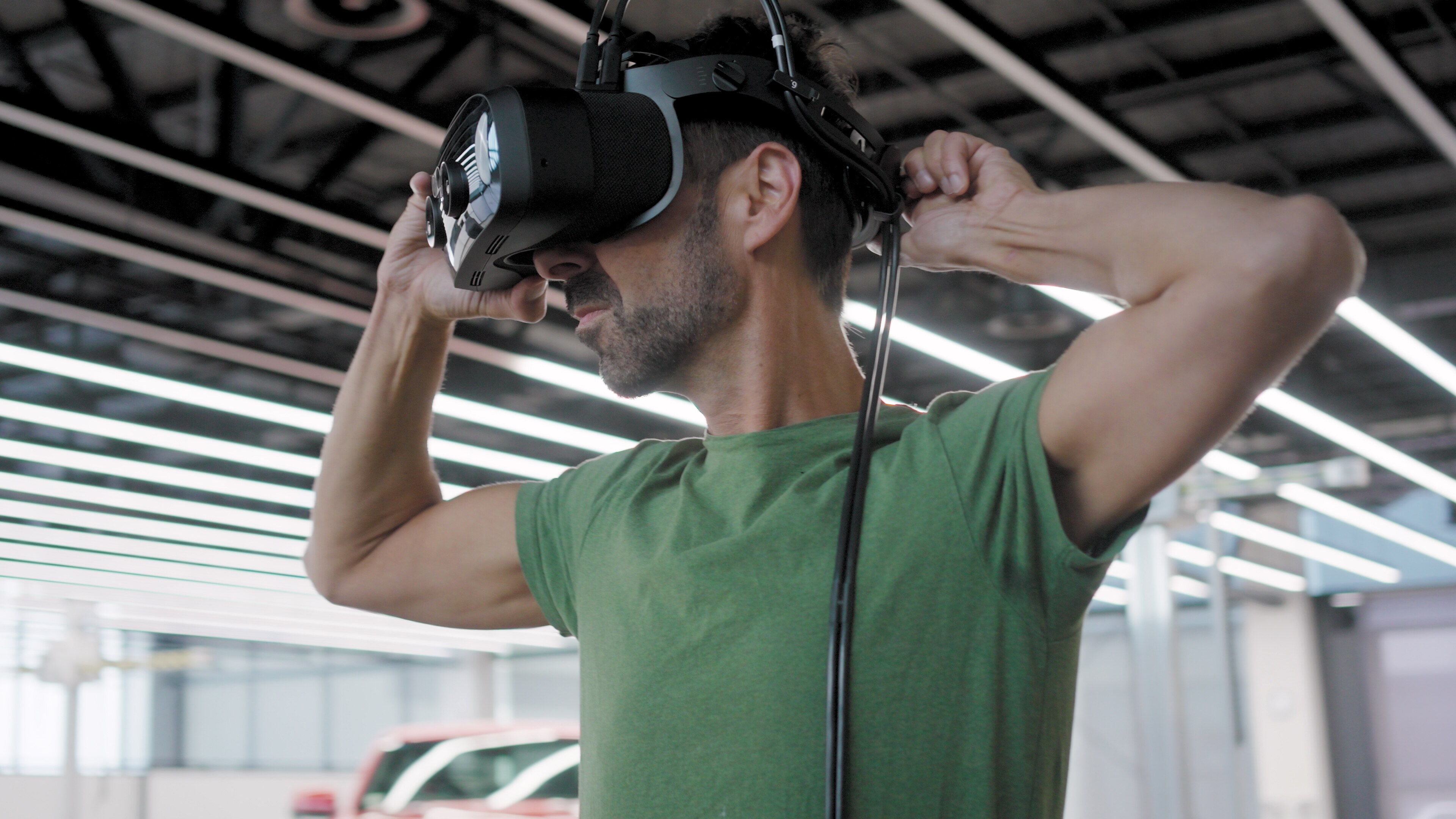

Andrew Dallan-Jones and Corey Middling from Ford Design explain how headsets that merge virtual and real worlds are revolutionizing how they create vehicles, and why people keep trying to peer into virtual holes in the floor.
From the Road: You both work with mixed reality technology at Ford Design in Australia. For people who haven't heard that term, what exactly is mixed reality?
Andrew Dallan-Jones, visualisation manager: Right, so everyone's heard of virtual reality, that's like when you put on a headset and you're completely in a digital world, like a video game. Augmented reality is the opposite, you're seeing the real world but with digital information layered on top, like those filters on your phone.
Mixed reality is the sweet spot in between. You put on a headset and suddenly there's a Ford Ranger sitting right there in our studio, but it's completely digital. You can walk around it, get underneath it, even reach out and, well, you can't actually touch it, but your brain thinks you should be able to.
Corey Middling, visualisation technology specialist: The crazy thing is how convincing it's become. Andrew's not exaggerating, you'll be walking around a virtual vehicle for 20 minutes, completely absorbed, and then someone asks you to take the headset off. For just a second, you expect the car to still be there.
FTR: That sounds almost unsettling.
Andrew: [Laughs]It is. The technology has gotten so good in the last year and a half. We're using these Varjo XR3 headsets now, and the level of photorealism is just incredible. You have real faith in what you're seeing.
“You'll be walking around a virtual vehicle for 20 minutes, completely absorbed, and then someone asks you to take the headset off. For just a second, you expect the car to still be there.”Corey Middling, Visualisation Technology Specialist, Ford Design
FTR: How are you using this in the design process?
Corey: Everywhere. We start using it right at the beginning when we're exploring themes and conceptual ideas. Then once we've chosen a direction, we think our customers will love, we use it to really scrutinize every detail, inside and out.
Andrew: It's changed how we work with our clay modelers too. The virtual world has limitations, so we're not throwing away the traditional skills. We're still building physical prototypes and clay models. But now we can do so much more exploration digitally before we commit to building something real.
Corey: And that speeds everything up. Some parts of our process that used to take months now take weeks.
FTR: You mentioned clay modelling. Aren't you worried this technology might replace traditional design skills?
Corey: Not at all. We're designing a physical product that real people are going to drive. You can't replace that entirely with virtual tools. I like to think of it as part cutting-edge digital technology, part traditional craftsmanship.
FTR: I heard you created something called a "virtual pit" during development. What was that about?
Corey: So, when we were developing this mixed reality capability, we wanted to demonstrate to our colleagues how natural and intuitive the experience had become. We created this virtual hole that would appear in the studio floor when you put the headset on.
Andrew: The reactions were amazing. People would walk very carefully up to the edge and try to look down into it. You could see their brains processing that it wasn't real, but their bodies were treating it like it was completely real.

Corey: That's when we had this lightbulb moment. We thought, "What if we put a vehicle down in this pit and could raise and lower it on a platform?"
FTR: Why was that useful?
Corey: Well, normally if you want a top-down view of a physical prototype, you have to go up to the mezzanine level. But with the virtual pit, designers can just stand around it naturally and look down. It gives you perspectives that are really hard to get with physical models.
Andrew: It started as a demo to show off the technology, but we realised it solved a real design problem. Those are the best kinds of innovations, the ones that happen almost by accident.
FTR: This must change how you collaborate with teams around the world.
Andrew: Completely. We work with design teams in the US, Europe, China. Everywhere. Before, they'd have to fly to Australia when the design was at a very advanced stage. Now we can conduct high-resolution, face-to-face design reviews in real time.
We can meet more often because we're not dealing with travel schedules. Getting a real-time decision from a design director while you're in the middle of working through something, that's incredibly powerful.
FTR: What's the learning curve like for designers who are new to this technology?
Corey: It's surprisingly intuitive. The whole point is that it feels natural. Most people put the headset on and within a few minutes they're walking around the virtual vehicle like it's been there all along.

Andrew: The hard part isn't learning to use it, it's learning to trust it. Designers have spent their whole careers relying on physical models. Building confidence that you can make real design decisions based on what you're seeing virtually, that takes time.
FTR: Where do you see this technology going next?
Corey: The fidelity keeps improving. Materials, lighting, reflections, everything is getting more realistic. At some point, the line between virtual and physical is going to be completely blurred.
Andrew: For us, it's about integration. How do we make moving between virtual and physical feel seamless? How do we use these tools not just for visualization, but for the entire design workflow?
Corey: We're not trying to replace everything traditional. We're adding tools to make the work we love doing even better. It's still about creating vehicles that people will love to drive, we just have new ways to explore what that looks like.

