
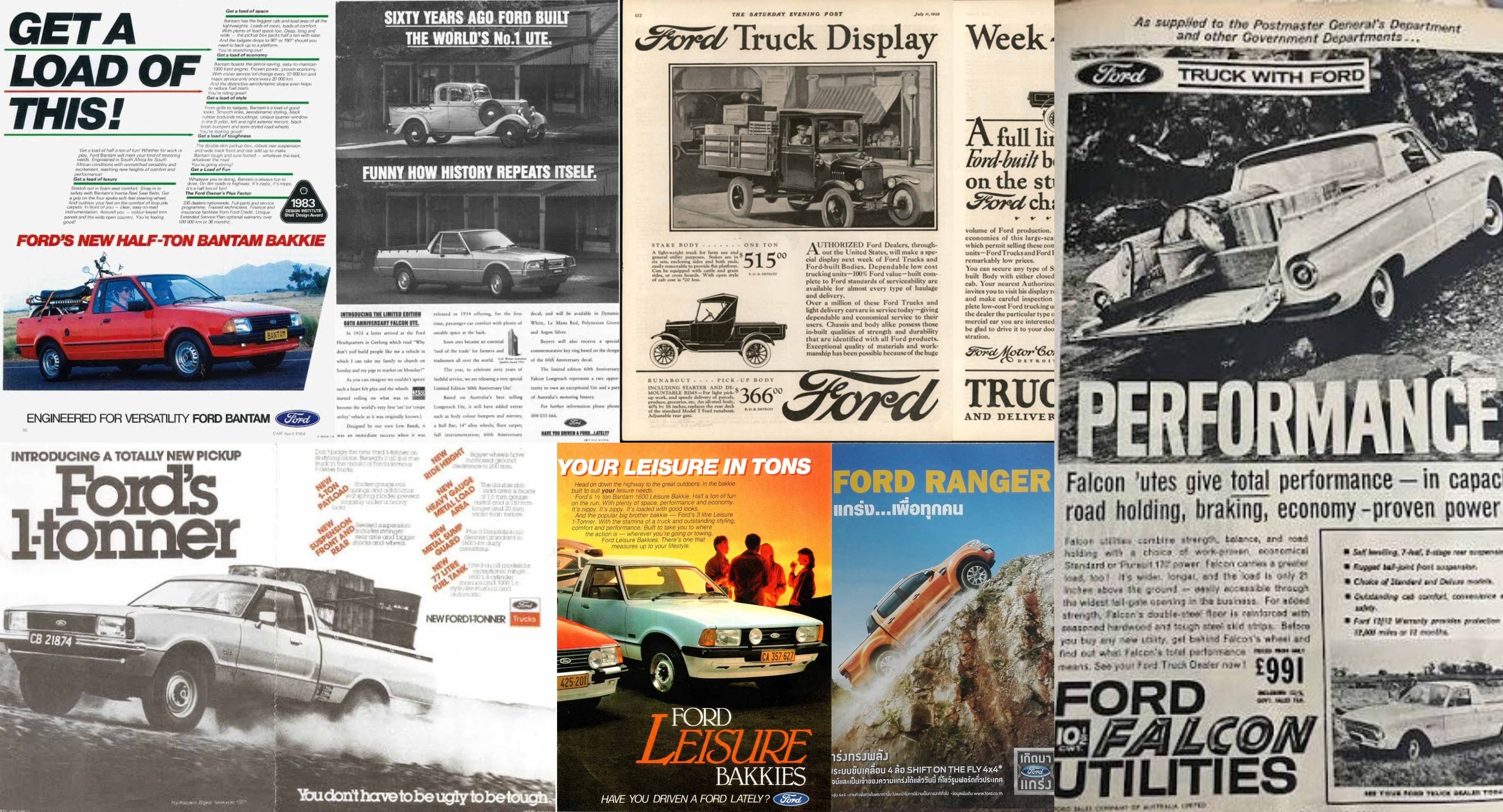
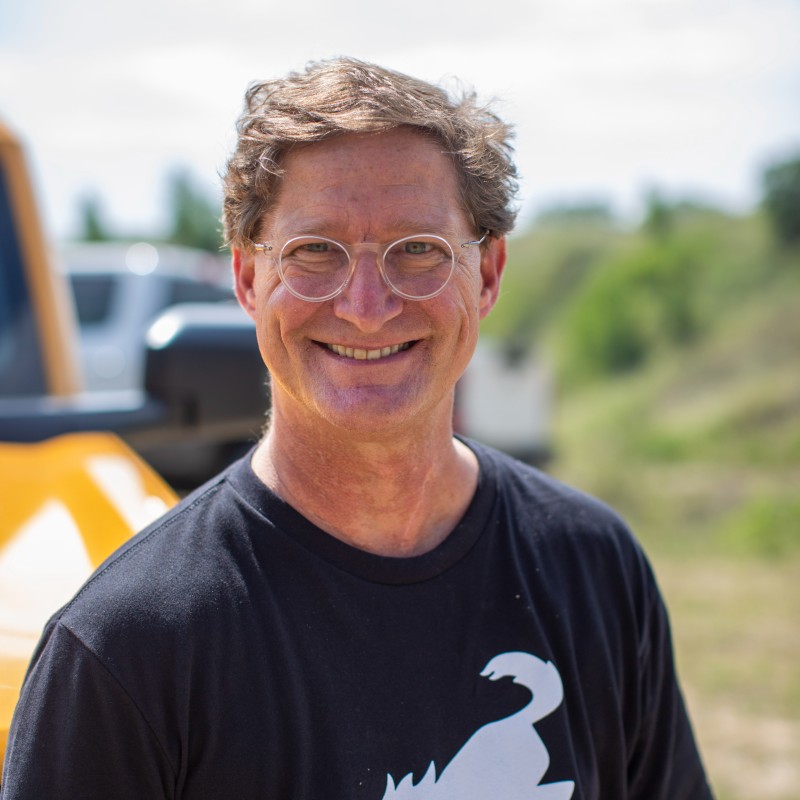
I spend my days surrounded by a century's worth of paper, photographs and metal. As Ford's heritage manager, I've catalogued everything from Edsel Ford's personal correspondence to the original brochures of the Model T. But every now and then, I stumble across something in the archives that stops me cold. Not because it's rare or valuable, but because it connects dots I never knew existed.
This is one of those stories.
It started with a question that sounds simple: what do you call a pickup truck? The answer depends entirely on where you're standing. And when you trace each word back to its origins, every single one leads to the same company.
More than that, they lead to the same vehicle.
A letter from the bush
The story I tell most often begins in the early 1930s, during the worst of the Great Depression. According to Ford folklore, a farmer's wife in Gippsland, Victoria, wrote to Ford Australia in 1932. (Some sources say 1933.) She wanted a vehicle that could take the family to church on Sunday and take the pigs to market on Monday.
I've never found the original letter. Ford's records say it hasn't survived. The wording usually quoted is a popular reconstruction, not an exact transcript.
The letter went to Hubert French, Ford Australia's managing director. It was passed to the sales manager and the plant superintendent, and then it reached a young designer at the Geelong plant, Lewis Bandt. He was in his early twenties.
.jpg)
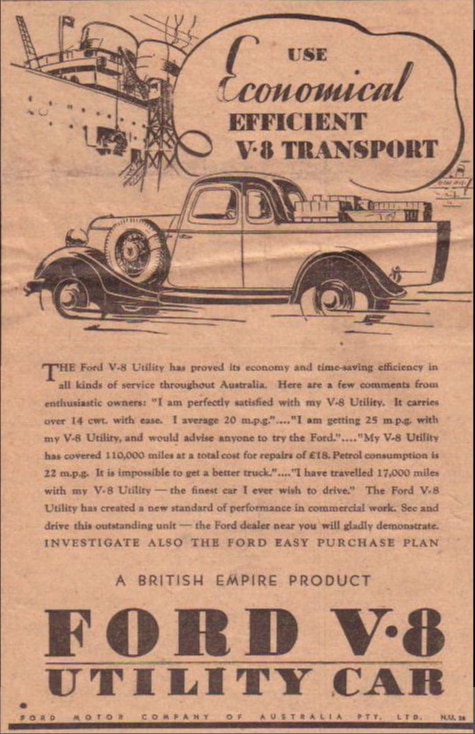
Bandt did not invent the idea of a car-based utility. Farmers had long fitted timber trays to old Model T cars, and body builders had made utility bodies on car chassis before the 1930s. Bandt's contribution was a more integrated version. He joined the front half of a Ford V8 coupe to a purpose-built rear frame, load tub, tailgate and one-piece side panels. The result was one vehicle that was comfortable enough for Sunday and tough enough for Monday.
The Ford Coupe Utility went into production in 1934 and reached showrooms that May. Australians shortened the name to "ute," and the word is still in everyday use.
Bandt later recalled that when two Geelong-built utilities were shown to Henry Ford in the United States, Ford called the design a "kangaroo chaser." That is Bandt's own recollection, from an interview decades later. I haven't found a contemporary document that confirms it, and sources differ on the date (the Australian Dictionary of Biography gives 1935) and on the place (Dearborn or Detroit).
Ford Australia's design and engineering teams are still based in Victoria. They work at several sites, including the Broadmeadows Design Centre and the You Yangs Proving Ground. The local team leads development of the Ranger, Ranger Raptor and Everest. Ford is Australia’s largest direct automotive employer, with a passionate and talented team of around 1,500 engineers, designers, technical, and other automotive specialists working at five locations across Victoria, in the long shadow of Lew Bandt's legacy.
From kitchen containers to the open road
Fly west across the Indian Ocean to South Africa, and nobody calls it a ute. There, the pickup is a bakkie (say it like "buck-ee").
The word is older than any truck. It comes from the Afrikaans bak, meaning a bowl or container, plus the diminutive ending -kie. It means, roughly, "little tray." Dictionaries record it first for household and farm containers. Over time, South Africans applied it to light open-bed vehicles too. Several brands' small trucks, Ford's among them, picked up the nickname.
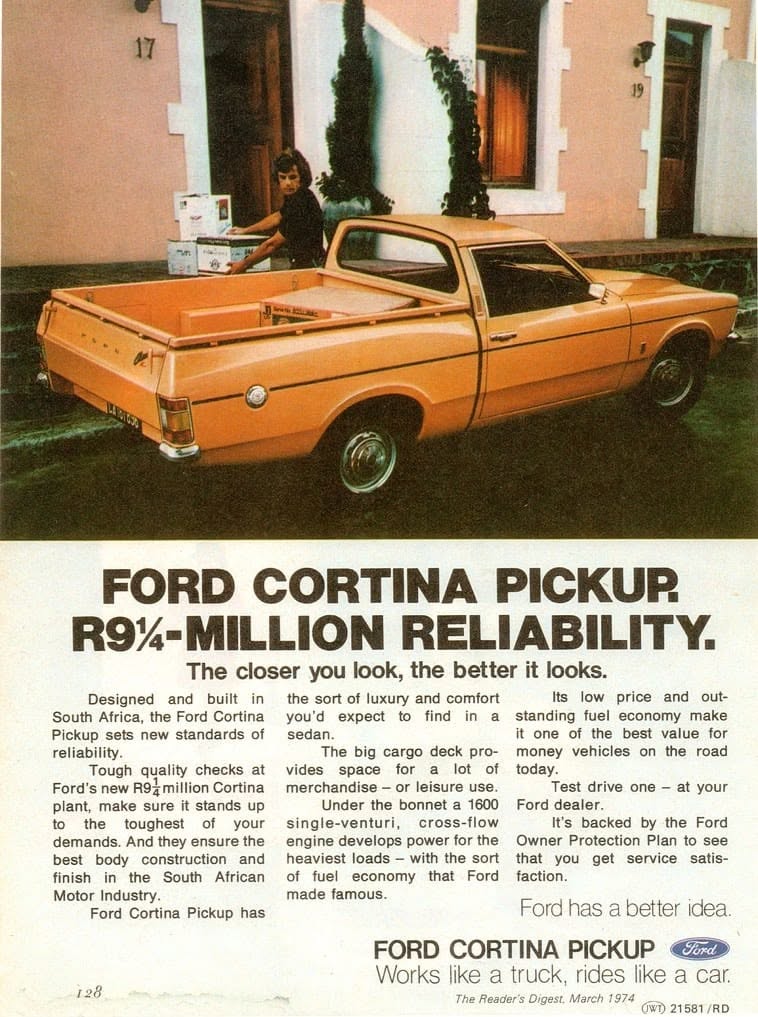

Ford then helped popularise the word. In 1971, Ford South Africa launched a Cortina bakkie based on the third-generation Mk3 Cortina. It was a car-based workhorse that was comfortable on the highway and could still carry a load. It was first offered with a 1.6-litre Kent engine, and a 2.5-litre Essex V6 followed soon afterwards. A 3.0-litre V6 arrived later, in the Mk IV-based model of 1977.
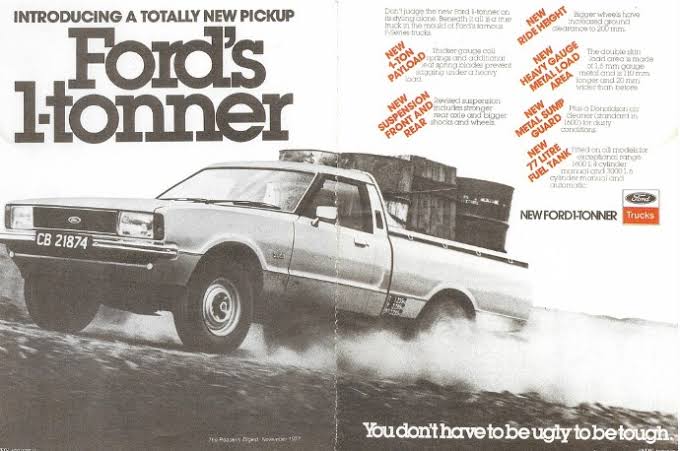
In 1976, the New Zealand All Blacks toured South Africa for a high-profile rugby series. To mark the tour, Ford released a limited-edition Cortina Springbok. It was painted in emerald green and gold to echo the national team's colours, and it carried Springbok heads on the doors. Locals nicknamed it the "Bokkie Bakkie." Only a limited number were built.
.jpg)
The Cortina pickup was followed by the Bantam bakkie in the 1980s. Based off the Escort MkIII, the Bantam boasted a South African-developed load box, tailgate, rear lights and a bespoke leaf-sprung rear end. Built on a monocoque frame, this type of pick-up is colloquially referred to as half-tonners. There would eventually be three generations of Bantam before it was discontinued in 2011.
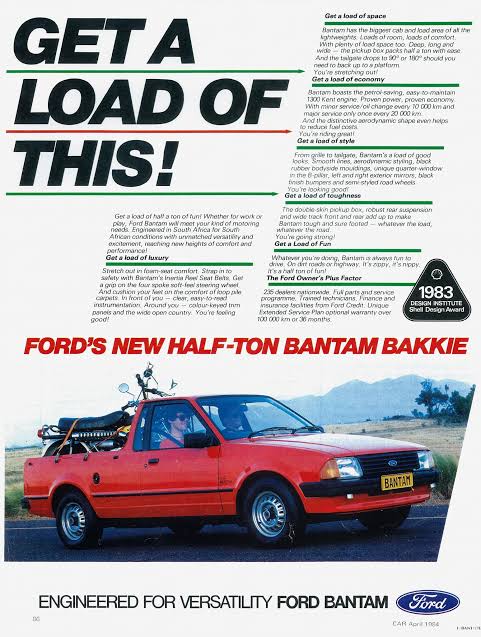
A kitchen word became a farm word, and a farm word became the name of a vehicle. Eventually even a special-edition truck earned its own nickname from it.
Today Ford's Silverton Assembly Plant employs thousands of people, and it builds the Ford Ranger for South Africa and for export around the world. The Cortina bakkie is long gone, but the word it helped spread is still the everyday name for a pickup
My father always had bakkies
When Europeans ask me what a bakkie is, I tell them it’s more than transport. It’s part of you, blending playfulness, adventure and hard work.
I grew up with bakkies because my father always had them. At 12, an elderly neighbour asked me to drive his Ford Cortina 3.0-litre bakkie between farms, about 15 kilometres. The power and sound were epic. I could hardly believe I was in control.
That sound stays with you. Anyone who grew up in South Africa in the ’80s or ’90s knows the rumble of an Essex V6. You don’t forget it.
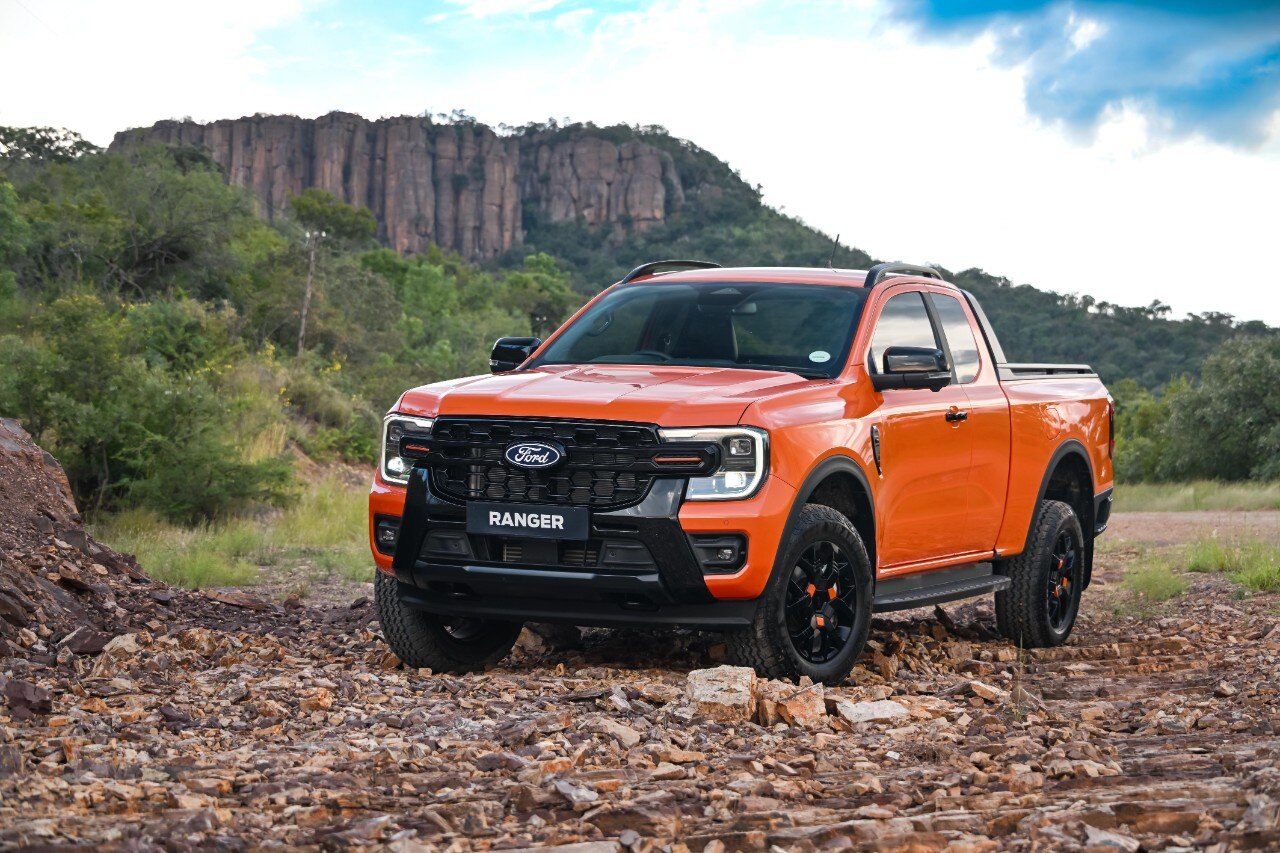
Today, I own a 2013 Ford Ranger 3.2 XLT Double Cab. I bought it new, and 13 years later it’s still my everything vehicle: family car, church vehicle, work bakkie and daily transport. It also lets me travel widely across Africa.
It doesn’t look stock anymore: bigger tyres, hi-lift suspension, dual fuel tanks and an off-road front bumper. I’ve built it for long overland trips through southern and eastern Africa, where you need complete trust in your vehicle.
My Ranger lets me travel anywhere in Africa with confidence.
.jpg)
In South Africa, “bakkie” immediately makes you think of your father. That’s how it was for me and still is. But the word has evolved. Modern bakkies are no longer just farm vehicles; they’re sophisticated, versatile and even a status symbol. You see them in city traffic, on the school run and on the highway to Kruger. The bakkie grew up but never forgot where it came from.
.jpg)
When people ask which bakkie to buy, I tell them there are only two choices: a new Ford Ranger or a second-hand one.
Marius Botha is a development engineer and pharmacist in Johannesburg, South Africa. He drives a modified 2013 Ford Ranger 3.2 XLT Double Cab.
The word that may have come from a number
In Saudi Arabia, Kuwait and much of the Gulf, the everyday word for a pickup truck is wanneit (وانيت). It doesn't look like an Arabic word, and one popular explanation is that it isn't one.
The story goes back to the early days of oil in the region. Commercial oil was struck at Dammam Well No. 7 in 1938. The company then was the California-Arabian Standard Oil Company (CASOC), renamed the Arabian American Oil Company, or Aramco, in 1944. As operations grew, the company brought in trucks to support work across the desert.
According to one widely repeated account, those trucks carried serial numbers beginning with 18, and employees called them "one-eight." Local workers adopted the English sounds, and "one-eight" became wanneit. Because Aramco was reportedly among the first to bring such trucks into the country, the name then spread to every pickup that followed.
There is a caveat. A competing version says "1-8" was the number of the garage where the truck was parked. The origin of the word is not documented, and some people list it simply as "origin unknown."
Whatever its true source, the word shows how everyday language changes when people from different cultures work side by side.
I grew up in a home where we always had a wanneit
Here in the Gulf, this type of vehicle is a wanneit. It’s not a heavy-duty truck; it’s something like the Ranger that you can use every day.
I grew up in a home where we always had a wanneit. Every vehicle I learned to drive was one, so they’re part of my childhood: climbing into the cargo bed, watching my father load it, riding into the desert. By the time you can drive, it feels natural.
My Ranger is part of daily life. I use it on the farm, with crops and animals, for family trips and my commute. That’s what outsiders don’t always understand: a wanneit isn’t for one type of person. It fits work, daily life and weekend adventures.
“I grew up in a home where we always had a wanneit. Every vehicle I learned to drive was one, so they’re part of my childhood.”Abdulrahman Hasan Muhareb
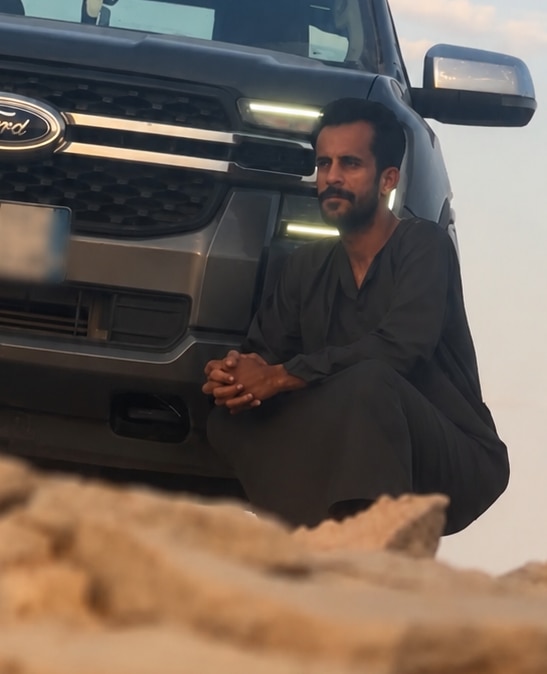
I love adventure. Even in summer, I enjoy heading into the desert. I’ve driven more than five wanneits, but the Ranger’s comfort makes work and adventure easier to enjoy.
Driving into the open desert never gets old. The light changes, the sand shifts under your tyres, and you feel alone for a hundred kilometres. A wanneit is made for that feeling.
Abdulrahman Hasan Muhareb is a government employee and farmer in Riyadh, Saudi Arabia. He drives a 2023 Ford Ranger.
The tray car
Thailand doesn't just love pickup trucks. For years, pickups made up about half of all new vehicle sales in the country, with the share varying from year to year. In 2022 it was about 46%.
The Thai word for a pickup is kraba (กระบะ, often written "grabba"). It is commonly understood to come from a word for a tray, and rot kraba is usually translated as "tray car."
Thailand embraced the pickup. At first, it was all about work, but the market changed over the years, and work and play began to blend. The Ranger Wildtrak, introduced in Thailand in 2009, reflected that shift. The Ranger Raptor continued it, with a reveal in 2018.
Ford has invested more than USD$3.9 billion in Thailand since 1995. That includes two manufacturing operations in Rayong province: AutoAlliance Thailand (AAT), a joint venture with Mazda, and the wholly owned Ford Thailand Manufacturing (FTM).
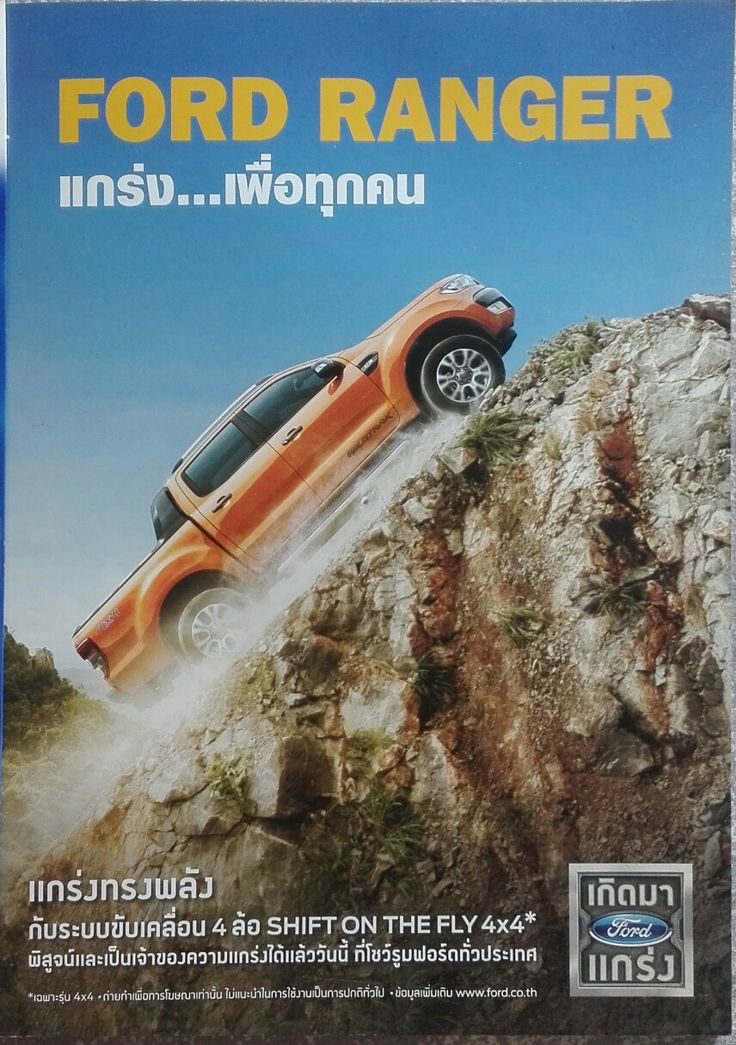
When it came time to reveal the first-ever Ford Ranger Raptor, Ford held the event in Bangkok on February 7, 2018. Sales began later in some markets.
Thailand is a country where trucks matter.
Where it all began
Many of the stories in this piece share a common thread: people who needed one vehicle to do the work of two.
In the early years of the Model T, buyers who wanted a light truck often bought a car and fitted a wooden bed themselves. Aftermarket roadster trucks were popular, and coachbuilders and dealers offered pickup bodies. Ford already sold trucks by then, including the 1-ton Model TT from 1917, but it did not yet offer a factory-built light pickup.
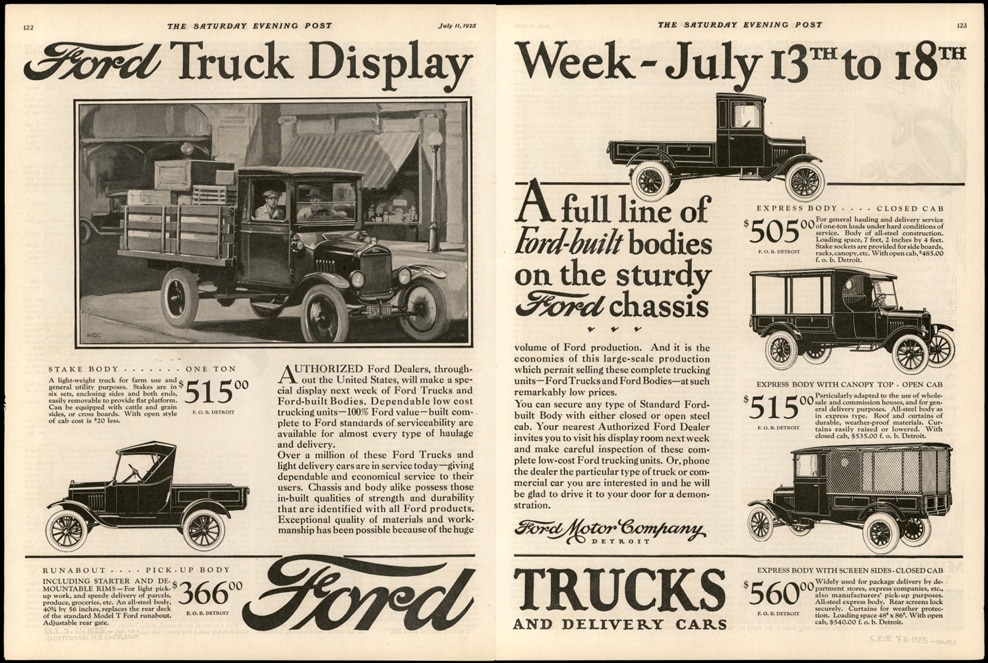
In spring 1925, Ford changed that. The company announced the Model T Runabout with Pickup Body, a factory-installed steel pickup bed with an adjustable tailgate and four pockets for stakes. The base price was $281, or $366 with a starter and demountable rims.
It was Ford's first factory-built pickup, and it is widely regarded as the first mass-produced one.
.jpg)
The ute, the bakkie, the wanneit and the grabba each have their own origin. The Australian ute was Lew Bandt's integrated design in 1934, and the bakkie takes its name from the Afrikaans word for a container. Different places, different words, and one shared need: a vehicle that works as hard as the person driving it.
Five words, one global truck from Ford
I started this with a simple question. What do you call a pickup?
Australia's answer began with a farmer's wife's letter, as Ford tells it. America's answer came in 1925, with Ford's first factory-built pickup. In Thailand, grabba became the common term and in South Africa, bakkie, in the Middle East it’s still referred to by some as a wanneit.
Those answers developed in parallel, shaped by the land, the language and the people who needed a truck to keep up with their lives. What fascinates me is that these stories don't just share a past. They share a present.
The Ford Ranger is developed by a team led from Victoria, Australia, including the Broadmeadows Design Centre, in the same state where Lew Bandt designed the first ute. It is built at Ford's plants in Rayong, Thailand and Silverton in South Africa. It is part of a lineage that includes Ford's 1925 factory-built Model T pickup.
Different places, different words, one shared need: a vehicle that works as hard as the person driving it.
Ted Ryan is the heritage brand manager and archivist at the Ford Heritage Vault.
