
Ford’s Universal Electric Vehicle project is one of the most audacious and important projects in its history.
Following the introduction of the UEV Platform and Production System last year, we’re excited to share this next chapter about how Ford is taking on the challenge of the electric vehicle cost equation by chasing physics.
Join the UEV team for an in-depth look at how they approached the new platform to deliver more value for users, starting with a mid-size electric truck in 2027.
Want to keep up with the latest on Ford electric vehicles?
- Subscribe to Ford From the Road by clicking the link below
- Select Electric Vehicles or Universal Electric Vehicle as an interest
- Opt in to communications to receive the latest updates
Stay Informed About the UEV Journey
Already subscribed? Log in to your From the Road profile and make sure you are subscribed to receive updates for Electric Vehicles.
You Asked, We Answered
Thanks for tuning into “Ford Bounty Hunters: The Pursuit of Efficiency," and thanks for the great questions. Let’s get into it:
Q: Will this project be spiritually similar to Chrysler's old K platform in the way that they build the vast majority of their future cars on said platform? Also, will it be adaptable to accept more advanced battery technology over time?
A: The UEV platform is designed to be highly flexible and will support a family of vehicles across multiple body styles (from B-car sized up to commercial vans). It is also engineered to be flexible for multiple chemistries and form factors beyond the initial Lithium Iron Phosphate or LFP battery, allowing it to adapt to future advancements.
Q: Will you offer an SUV on this platform? If so, when?
A: The platform is highly flexible and will support multiple body styles beyond the initial mid-size truck. While we have not confirmed a specific SUV model or timeline yet, the architecture is capable of supporting vehicles ranging from small cars to vans.
Q: Will Ford's Universal EV platform be used for future Mustang Mach-E?
A: No, it will not be used for the Mustang Mach-E. This platform was built from a clean sheet to maximize vehicle efficiency.
Q: Is the goal to extend range as far as possible on the UEV, or is there a certain threshold of range, say 300 miles, that Ford deems sufficient to balance cost and range anxiety?
A: Our strategy is to meet the expectation of some customers of around 300 miles of range. Instead of using larger, more expensive batteries to achieve this, we are focusing on extreme vehicle efficiency through aerodynamics, weight reduction, and energy management to achieve similar range with a smaller, lower-cost battery.
Q: When you say a "mid-size" pickup, do you mean Maverick or Ranger? With an increased emphasis on aero, does that mean that the new pickup may introduce a new design image away from the traditional pickup?
A: The truck will be comparable in footprint to a Maverick, but because it is a clean-sheet EV design, the only similarity to Maverick is the size comparison.
There will be significantly more interior space — more than a 2025 Toyota RAV4 — plus a frunk and a bed. To be clear, this vehicle won’t look like a Maverick.
Q: Will the Universal EV platform be available in Europe/UK?
A: The UEV is a globally capable platform, and Ford plans to export vehicles. However, we aren't sharing specifics on where and when yet.
Q: Will these vehicles also be built in right-hand drive format?
A: The platform is capable of right-hand drive, but we have no specifics to share currently.
Q: When are deliveries to dealers expected to begin?
A: The mid-size electric truck will arrive in 2027.
Q: What work is being done in terms of ensuring that there is charging infrastructure to support these new EVs?
A: We learned from our gen 1 EV customers that the majority of people are charging at home. For UEV, we are focused on delivering efficiency, and that is also good news for charging efficiency.
Our goal is to deliver more miles of charge for home charging, whether that is with a level 2 charger or on a standard 120V outlet with the aim of reducing barriers for EV adoption.
This will be a great option for those just using their EVs for a commute to and from home. For those on the go, we still have the largest integrated network, called BlueOval Charge Network, which gives customers access to 180,000 public chargers across the United States.
Q: How will the vehicle be able to charge at existing public and home charging stations?
A: The vehicle will be equipped with a NACS port. A charging adapter will be available for customers to use CCS DC public fast charging stations and a separate adapter will be available for J1772 charging stations, meaning both Level 1 (120V) and Level 2 (240V) AC charging stations, which includes Ford’s home charging wall boxes (Ford Charge Station Pro and Ford Connected Charge Station).
Q: Will this vehicle be capable of bi-directional charging?
A: The platform will offer bi-directional charging both Home Backup Power (V2H) and Home Power Management (V2G). The system utilizes an "E-Box" or Energy Management Unit that consolidates power conversion and distribution into a single module. More technical details on the hardware and integration will be shared closer to launch.
Q: What is the maximum charge rate of the new vehicle, and at the maximum rate, how long is it expected to charge from 10% to 80%?
A: We don’t have those specifics to share right now. With the platform’s aggressive efficiency targets, advanced power conversion, and minimized copper losses, the benefit of an 800V system isn’t there — cost/complexity would rise. For this vehicle’s energy needs and the customer we are trying to reach, 400V delivers the best cost with minimal downside.
Q: Are the unicastings repairable?
A: We started by working hand in hand with both insurance companies and our team that creates repair instructions for our dealerships. Ford has decades of crash information and repair/insurance experience to work with. Without giving away the entire secret sauce, we can say that we are confident we will not have repairability issues.
Q. Will the mid-size EV truck be built on the "tree" assembly system Ford introduced last August?
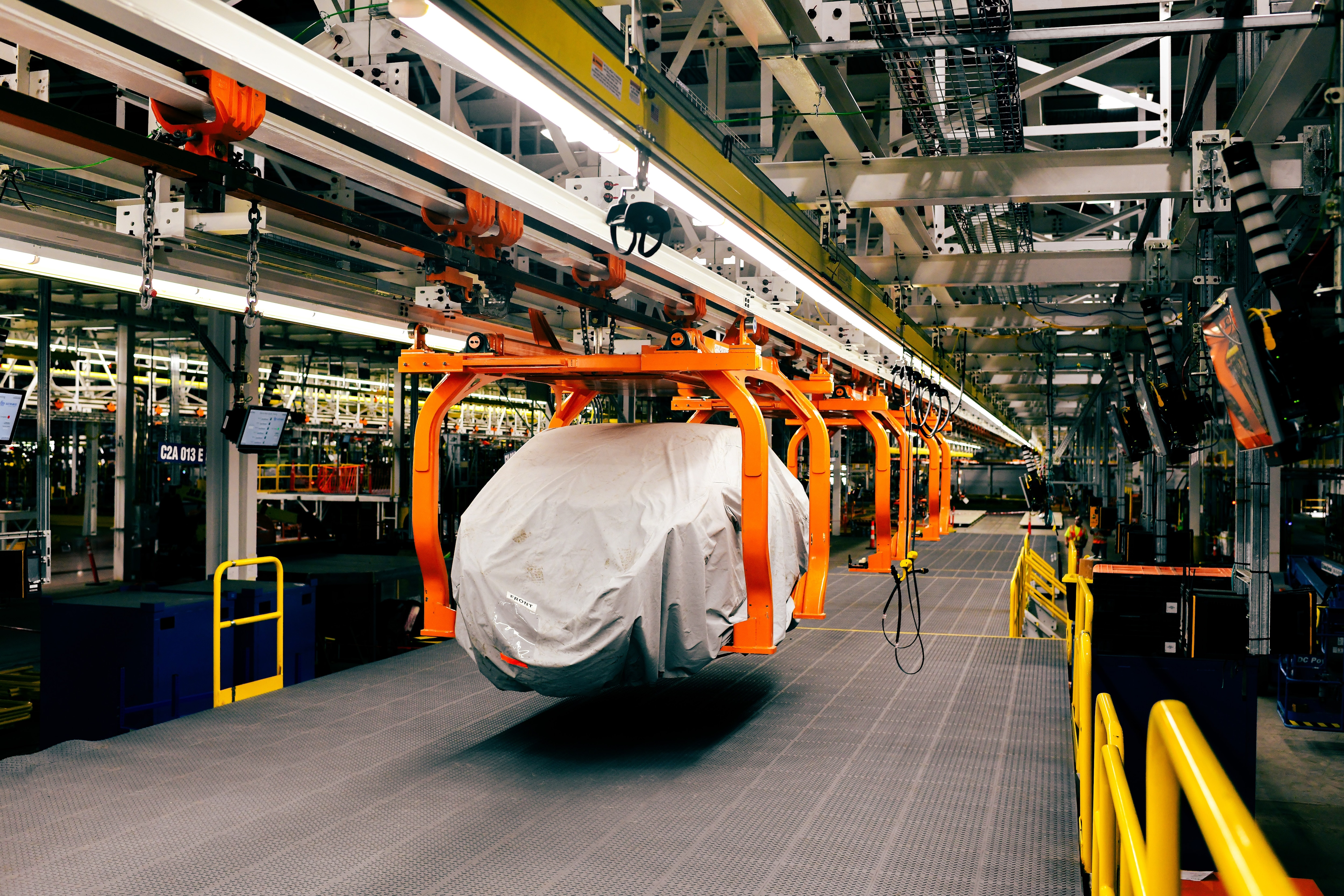
A. Yes. It will be built at the Louisville Assembly Plant using the new "assembly tree" process, which involves building the vehicle in three separate sub-assemblies including front, rear, and structural battery core.
Q: Can cells be individually replaced?
A: The battery pack is serviceable, but individual cells cannot be replaced due to the dual structural function they serve. We are using software to detect and constantly monitor the life of every individual cell. It will allow us to understand cell performance over time and optimize the charging, discharging, temperature, and health to improve performance of its life.