


Let’s be clear about what’s at stake here. Every single morning across Europe, millions of people get into a vehicle and go to work. The electrician rewiring a house in Munich. The plumber fixing a boiler in Rome. The logistics driver running the final mile in Warsaw.
Their livelihoods depend on commercial vehicles that are tough, reliable, and affordable. Those vehicles do not come from a single factory in a single country. They are powered by a deeply integrated, highly competitive European industrial machine.
Right now, European policymakers are debating the Industrial Accelerator Act and asking a fundamental question: What actually counts as “Made in Europe”?
The EU is right to ask. In a world of intensifying geopolitical competition and supply chain vulnerability, strengthening our industrial resilience isn't optional.
If we want a strong European automotive industry we must not only retain and strengthen the ability to build parts and components in Europe. The Act must also recognize final assembly of vehicles in neighbouring countries, such as Türkiye and the U.K., where European automakers have built cars and vans for decades. The danger is that policymakers define the geographical scope too narrowly and risk disrupting, not strengthening, the existing ecosystem that spans the EU27 and its closest neighbours.
My position is straightforward: "Made in Europe" should be measured by where value is created, not where the last bolt torqued. That means extending EU27-equivalent treatment to final assembly in close, trusted partners such as Türkiye and the U.K., with strong safeguards against circumvention.
Today, we see research and development in one country. Advanced battery technology in another. High-precision supplier networks feeding assembly hubs across borders. This ecosystem is Europe’s competitive edge. It gives manufacturers the scale to invest billions in technology, keeps supplier networks alive, and protects affordability for the small business owners who keep the economy running.
If industrial policy ignores this reality to chase the optics of where final assembly happens, the EU doesn’t get stronger. It gets slower, more fragmented, and less competitive.
The Proof Point: Ford E-Transit Custom
You don’t have to look at theory. Look at reality. Look at the electric Ford Transit Custom—the backbone of commercial fleets across Europe.
• Engineering: Design and engineering led by Ford in the UK and Germany.
• Electric Powertrain: The electric drive units are built in Halewood, U.K.
• Battery Systems: High-voltage batteries are sourced from the EU27.
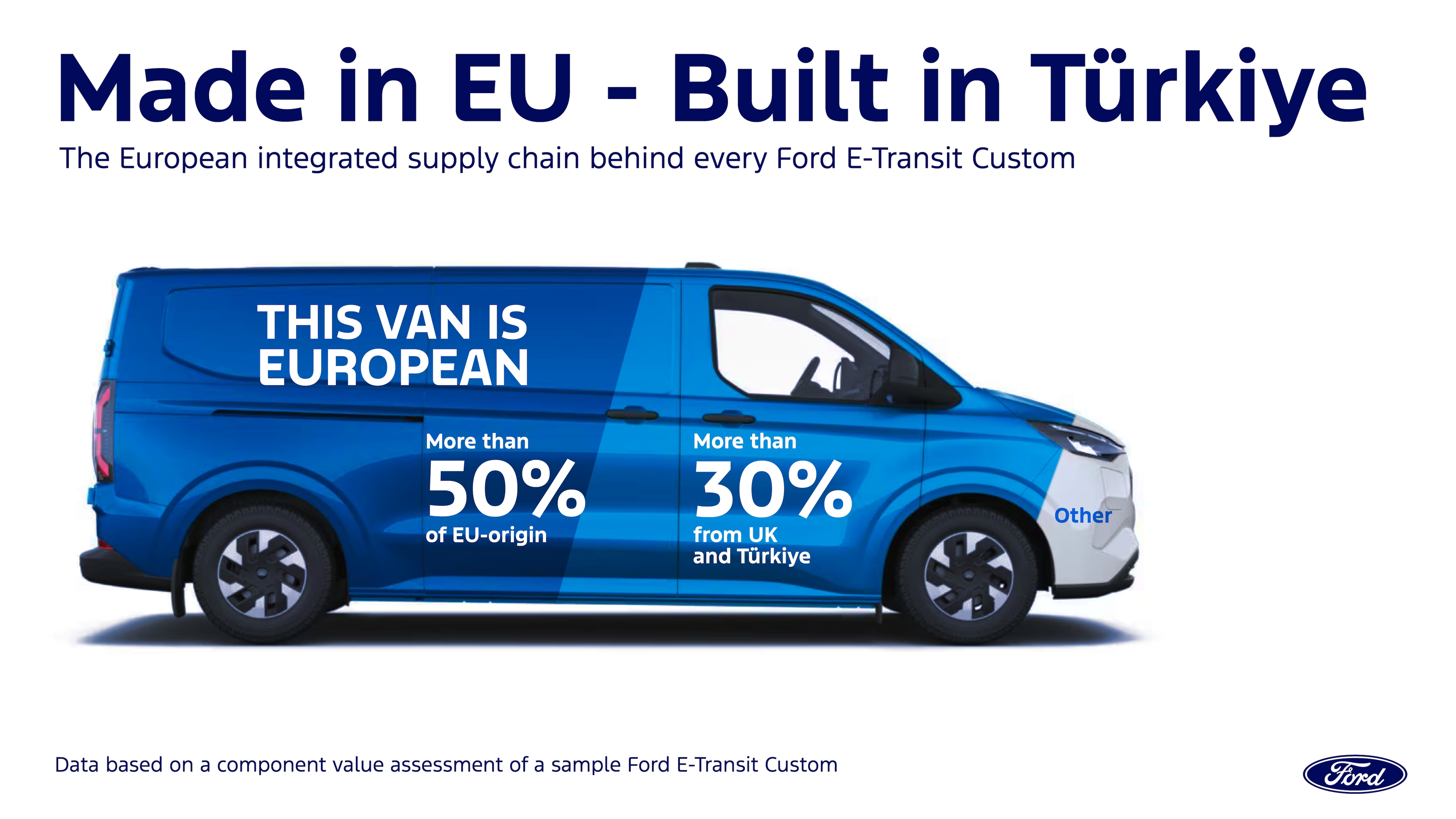
• EU Value: More than 50% of total component value originates strictly within the EU27.
By any economic measure, this is a European vehicle. Yet under a narrow reading of the Act, all that European engineering, supplier work, and battery investment risks being written off simply because final assembly happens at our joint-venture plant in Türkiye.
Automotive is being singled out here. Other sectors covered by the Act face no comparable EU27 final assembly conditions. That doesn't make sense.
You cannot celebrate European technology, subsidize European batteries, and depend on European component suppliers, and then declare that value invisible the moment the vehicle rolls off an assembly line. Excluding Ford E-Transits built in Türkiye could also undermine the EU27 battery supply chain, ultimately harming the very industrial ecosystem the policy is intended to support. Close, trusted partners that are deeply integrated into Europe's industrial base belong inside the definition.
Protect Affordability. Protect Competitiveness
This isn’t just an industry issue. It’s a direct hit on our customers. Commercial vehicles are the lifeblood of the European economy. They drive €1 trillion in productivity across the EU and UK, 1 powering the small- and medium-sized businesses that make up 99% of all European firms. 2 These aren’t abstract corporate statistics. These are working tradespeople and business owners who rely on these vans every single day.
Forcing companies to rebuild efficient, proven regional supply chains to satisfy arbitrary geographic rules drives costs straight up. Suppliers lose scale. Production costs spike. Our data shows small businesses can save €14,000 per van over three years by switching to electric. 1 The last thing they need is for that case to erode just as policy demands they move faster. Small business owners are the ones who would foot the bill.
“Policy should encourage the next investment decision. It must never punish the last one.”Jim Baumbick, President, Ford in Europe
The Bottom Line: Protect What Matters
Let’s be blunt about what industrial policy should do. Europe should compete fiercely for future capital. We should incentivize companies to bring high-tech engineering, battery production, and critical supply chains into Europe. That’s how you build long-term strength.
Policy should encourage the next investment decision. It must never punish the last one.
The investments sustaining European industry today were made under established trade frameworks and stable partnerships. Undermining those investments retrospectively doesn't bring new factories to Europe tomorrow; it signals to global investors that Europe's policy framework is unpredictable.
Europe faces a clear choice. We can define manufacturing narrowly, looking backward and protecting an outdated model of national assembly lines. Or we can pursue a forward-looking industrial policy that recognizes where economic value is created: where technology is designed, high-tech components are made, jobs are created, and capital is invested.
So, my ask of policymakers is simple: define "Made in Europe" by where value is created. Extend EU27-equivalent treatment to assembly in trusted partners like Türkiye and the U.K., with strong safeguards, and keep the vans that power Europe's small businesses within reach of the people who depend on them.
Jim Baumbick is President, Ford in Europe
1 May 2024 report by the Centre for Economics and Business Research estimating the economic activity in van-dependent industries across five national markets, plus the EU. Commissioned by H+K Strategies and Ford Motor Company.