Eight minutes.
That's the benchmark in fire and emergency services. From the moment a service is alerted to when the first vehicle arrives on scene, the service delivery standard for urban areas is eight minutes.
Sounds achievable. But getting the right capability to an incident quickly isn’t straightforward, and every minute matters. As communities grow, Australia's urban-interface zones (where suburban development meets bushland, and where fire risk is growing fastest) are expanding rapidly. More people, more houses, more complexity. The eight-minute window isn't getting any easier to achieve.
The question we asked ourselves was: could the newly launched Ranger Super Duty, with its extra capacity, be the platform that could help get first responders to an incident sooner?
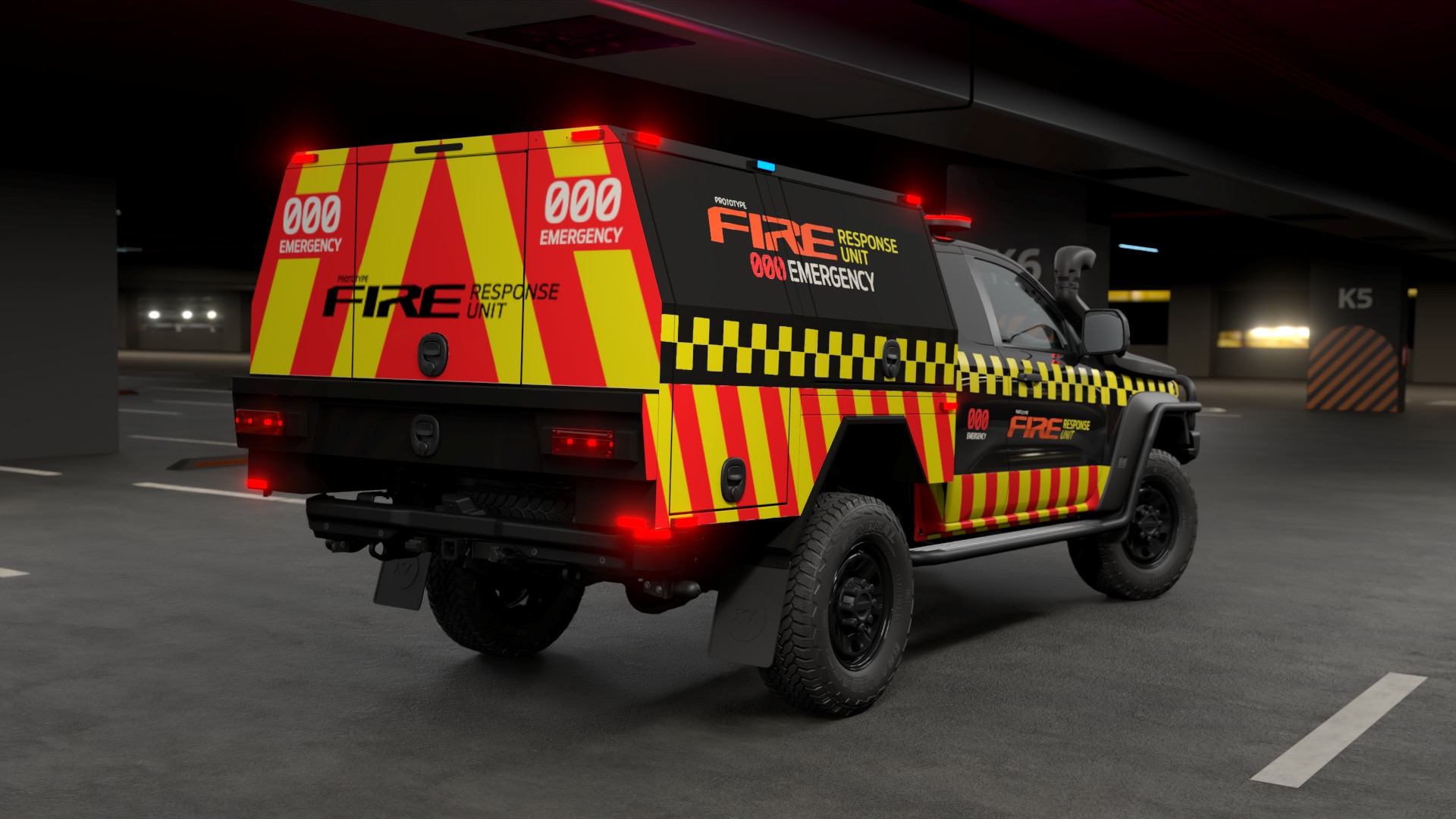
That answer became the Ford Ranger Super Duty Fire Response Unit Custom Build (Fire Response Unit) 1.
At a Glance: Ford Ranger Super Duty Fire Response Unit 1
- Base Platform: Ford Ranger Super Duty (Super Cab configuration)
-
Gross Vehicle Mass (GVM): 4,500 kg (Factory GVM 2, no aftermarket suspension upgrades required)
Gross Vehicle Mass (GVM): 4,500 kg (Factory GVM 2, no aftermarket suspension upgrades required)
-
Engineering Partners: Ford Australia, Deakin University (40-year R&D partnership), XL Service Bodies (certified upfitter), Zeliox Australia
Engineering Partners: Ford Australia, Deakin University (40-year R&D partnership), XL Service Bodies (certified upfitter), Zeliox Australia
-
Auxiliary Power: Integrated Zeliox solar-charging inverter system (Eliminates noisy diesel generators)
Auxiliary Power: Integrated Zeliox solar-charging inverter system (Eliminates noisy diesel generators)
-
Pumping Capability: Dual high-flow (1000 kPa at 500L/min) and ultra-high-pressure (3000 PSI at 18L/min) pumps controlled via 12-inch SYNC 4 infotainment screen
Pumping Capability: Dual high-flow (1000 kPa at 500L/min) and ultra-high-pressure (3000 PSI at 18L/min) pumps controlled via 12-inch SYNC 4 infotainment screen
-
Public Debut: AFAC Conference at Melbourne Convention & Exhibition Centre (August 18–20)
.png)
Public Debut: AFAC Conference at Melbourne Convention & Exhibition Centre (August 18–20)
How did the partnership between Ford and Deakin University begin?
Last year, I sat down with a team from Deakin University for a collaborative engineering session. I love solving complex puzzles.
We started by mapping what happens from the second someone dials Triple Zero. I kept asking: "What happens next? Then what? And then what?" All the way through dispatch, alerting, turnout, travel, arrival, and initial operations.
The mapping made one thing clear: there's a gap between when an incident is reported and when a fully equipped appliance (fire truck, in this instance) arrives. Many incidents, particularly in growing urban-interface zones, would benefit enormously from trained personnel arriving early with core capability: to assess the scene; establish communications; begin initial suppression; provide first aid; and/or confirm whether a full response is needed.
We weren't trying to replace traditional fire trucks or the firefighters who crew them. A Ranger Super Duty doesn't fight a house fire or a raging bushfire on its own. But it could carry the equipment needed to manage those critical first few minutes while the cavalry is on its way.
So, a small team from Ford and Deakin decided to build one. This project is the latest chapter in 40 years of collaboration between Ford and Deakin University, spanning education, R&D, and innovation to solve real-world challenges.
Why was the Super Cab chosen for the Fire Response Unit?
Our team visited local fire stations to audit the gear carried on a standard 15-ton urban appliance. These are serious machines, typically costing between $700,000 to $1.5 million each, carrying equipment for every conceivable scenario.
We stripped that inventory down to the absolute essentials for early intervention: a dedicated water supply, high-capacity pumps and hoses, mains connections for secondary water, breathing apparatus, first aid gear, recovery equipment, emergency lighting, and communications systems.
Choosing the cabin configuration required a careful balancing act:
-
Double Cab: Carries a larger crew of four or five but compromises the rear load area too much for essential heavy equipment.
.png)
Double Cab: Carries a larger crew of four or five but compromises the rear load area too much for essential heavy equipment.
-
Single Cab: Gives maximum tray space but leaves nowhere secure and weather-protected for sensitive electronics, first aid kits, and communications gear.
.png)
Single Cab: Gives maximum tray space but leaves nowhere secure and weather-protected for sensitive electronics, first aid kits, and communications gear.
-
Super Cab (The "Goldilocks" Solution): Delivers maximum tray space for heavy firefighting equipment out back, combined with secure, dry storage behind the front seats for sensitive gear.
Super Cab (The "Goldilocks" Solution): Delivers maximum tray space for heavy firefighting equipment out back, combined with secure, dry storage behind the front seats for sensitive gear.
Getting that layout right came down to the body-building expertise of Ford-certified upfitter, XL Service Bodies.
.png)
How were Virtual Reality (VR) and AR used to design the tray layout?
Fitting a fire station's worth of heavy equipment onto the back of a Ranger Super Duty was a masterclass in spatial design. Our brief was strict: build the custom body around the equipment, not the other way around; no compromising on access or ergonomics because something didn't quite fit an off-the-shelf service body.
We started in the digital realm. Using advanced CAD software, the Ford and Deakin engineering team packaged the layout, then projected it into a full-scale virtual reality environment. Wearing VR headsets, you could walk around the virtual vehicle, look inside compartments, and identify layout improvements before a single piece of metal was cut.
Then we bridged the gap between virtual and physical, building a full-scale mock-up on the back of a real vehicle. Using borrowed equipment from our sponsors and augmented reality overlays, we could physically test the ergonomics, pulling heavy breathing apparatus off the truck, accessing hose reels, reaching equipment under pressure. The kind of thing you can only validate with your hands.
How did engineers eliminate the generator to power high-pressure pumps?
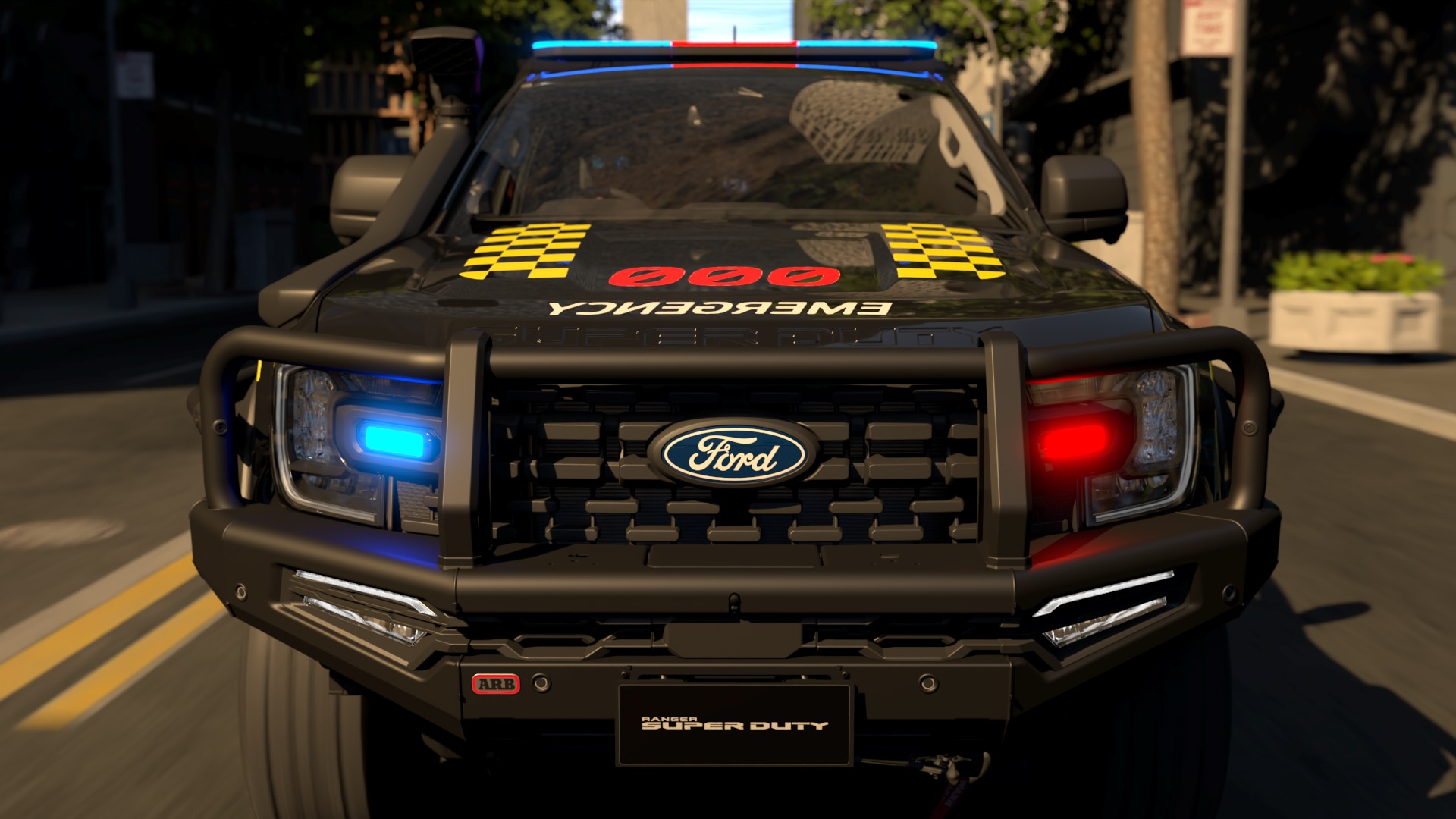
One of the biggest engineering challenges was powering a high flow 1000 kpa 500l/m and an ultra-high-pressure pump 3000PSI 18l/m to allow for the flexibility of tackling the fire type being presented.
The easy route would have been bolting a diesel or petrol generator onto the tray. Noisy, emissions-producing, and one more thing to maintain. We wanted to push further.
So, we partnered with Zeliox Australia to integrate an all-in-one inverter and charging system (with solar charging capability). It delivers the electrical output needed to run the pumps with reduced noise and less tailpipe emissions, straight from the vehicle's electrical architecture. No separate generator. Reduced noise (critical for residential deployments and night operations), simpler operation, and lower maintenance.
.png)
Furthermore, we integrated siren, lighting, and pump controls directly into the vehicle's existing 12-inch infotainment screen, keeping the cabin uncluttered and intuitive.
Developing the Fire Response Unit was a team game
To develop the Fire Response Unit 1, we listened to the emergency services industry and the real challenges they face. This was not a science project developed in isolation. To validate our hypothesis, we have presented it back to the industry and their positive feedback gives us confidence that we’re on the right track.
This has been a collaborative effort from the start. Ford Australia contributed vehicle engineering and the Ranger Super Duty platform. Deakin University brought research expertise, digital engineering capability, and prototyping resources. Zeliox Australia provided the electric power innovation, and XL Service Bodies built the customized service body solution.

But it was the people who understand frontline response who shaped what this vehicle became. Something that could help get trained personnel and critical equipment to an incident sooner, with the aim of supporting the broader industry goal of narrowing that response gap, especially in urban environments.
What is the role of Ford Pro and Ford Certified Upfitters in fleet conversions?
The Fire Response Unit 1 is designed to demonstrate what could be possible if the Ford Pro Convertor program were applied to a solution like this, Ford Pro is our dedicated commercial division covering vehicles, service, customisation, finance, and software designed to keep commercial and government fleets moving and supporting their communities.
Through the Ford Pro Convertor program, vehicle owners connect with 12 certified upfitters across more than 45 accredited sites in Australia and New Zealand. For highly specialised emergency services and mining fleets, Ford completes bespoke builds in-house at its Broadmeadows facility in outer Melbourne.
While the Fire Response Unit 1 is a concept vehicle right now, it’s a blueprint for a fleet solution that could be built, serviced, and supported nationwide.
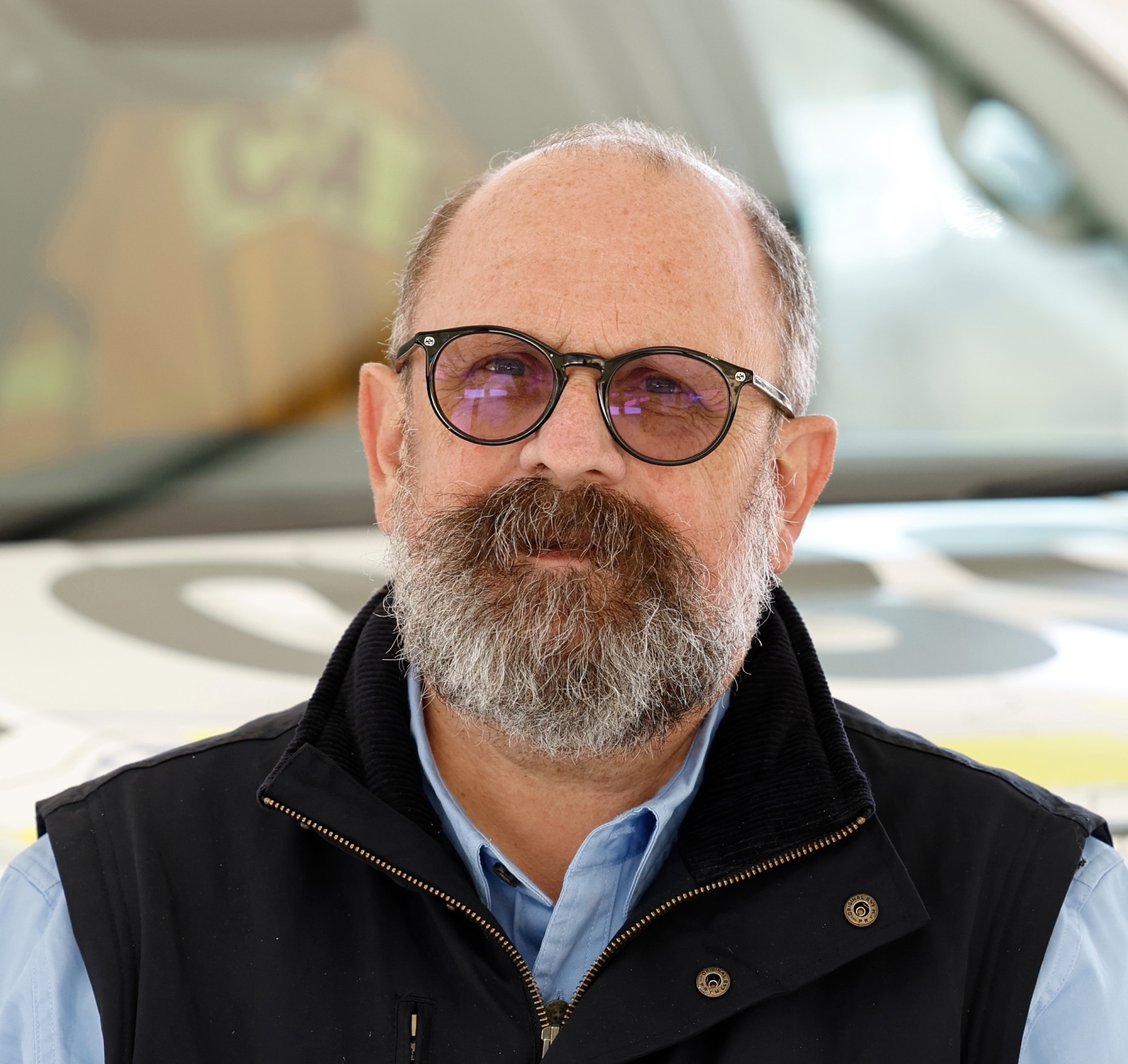
Jeremy Welch is the Ford Pro Conversion Development Manager for Ford Australia
The Ford Ranger Super Duty Fire Response Unit 1 is on display at the AFAC (Australasian Fire and Emergency Service Authorities Council) conference at the Melbourne Convention and Exhibition Centre, August 18–20.
1 The vehicle is a custom build for demonstration purposes only. It has not been certified or approved by any fire or emergency service authority.
2 Gross Vehicle Mass is the maximum allowable weight of a vehicle including any load transported by the vehicle, including tow ball down weight of a trailer but excluding the weight of a trailer itself. GCM is the maximum allowable weight of the vehicle and its trailer. Subject to state and territory regulations. Stated vehicle weights are approximate and subject to individual variances. Vehicles should be weighed before and after adding any load to ensure the maximum GVM, GCM and Gross Axle Weight Ratings are not exceeded.
.jpg)