.jpg)
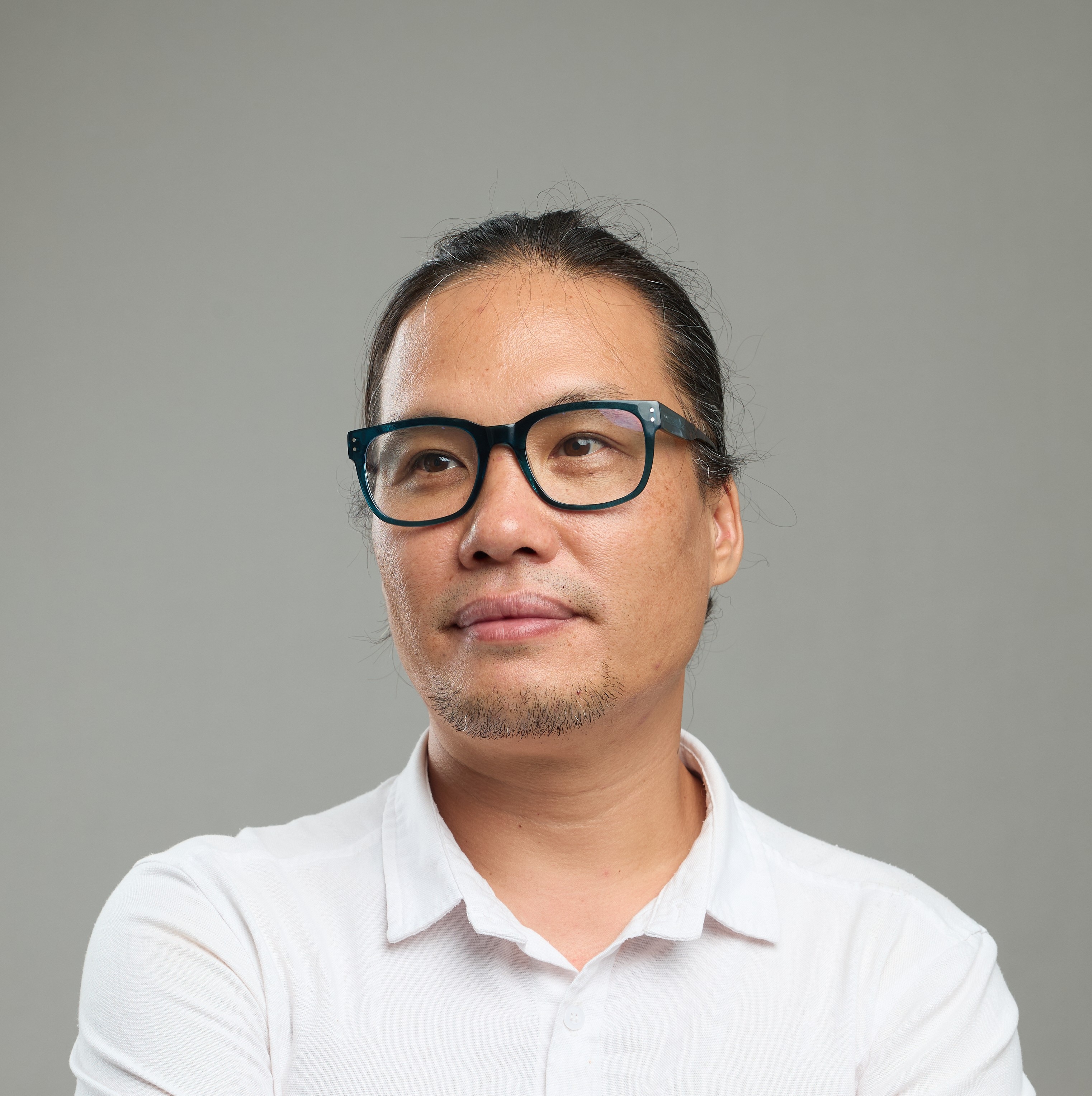
For Ford Vietnam's "Expand Your World with Territory" campaign, hyperrealist painter Trịnh Minh Tiến put five of Vietnam's oldest monuments onto the body of a Ford Territory. The interesting part is not that he did it. It is that a car is a genuinely terrible canvas, and here is why.
.jpg)
Hyperrealist painters work in a narrow margin. The whole discipline rests on the eye being fooled for a second or two: paint mistaken for photograph, a rendered reflection mistaken for actual wet glass. Get a highlight a shade too bright and the illusion collapses.
.jpg)
So, the hardest thing you could hand a hyperrealist is a surface that refuses to stay still, refuses to stay flat and refuses to hold the same light twice.
Which is what Trịnh Minh Tiến was handed.
Five monuments and one tailgate
Tiến has made his name painting the surfaces most people walk past: weathered facades, reflections, a film of water sitting on glass or metal. Architecture is his recurring subject, which is part of what makes this commission a logical extension rather than a stunt.
Across the body of a Ford Territory he rendered four sites: the Imperial Citadel of Thăng Long in Hanoi, the Cham temples of Mỹ Sơn, the Hồ Dynasty Citadel and the monuments of Huế, Vietnam's former imperial capital and Tra Co Church. Between them they span around 1,000 years of Vietnamese history.
Five monuments. One vehicle. No flat surfaces anywhere on it.
.jpg)
The cartographer's problem
Here is the thing about painting on a car, and it is the same problem mapmakers have been arguing about since the 1500s.
You cannot put a flat image onto a curved surface without distorting it. This is why every world map you have ever seen is wrong in some specific way: Greenland is enormous on one projection and sensible on another, because flattening a globe forces a choice about which lie you can live with. Mapmakers call these projections, and there are dozens, because there is no correct answer.
A car body is the same problem running backwards. Instead of flattening a curve, you are wrapping a flat scene onto one, and not a simple curve either. A door is a compound curve, bending in two directions at once, with a crease line through it and a handle in the way. A bonnet falls away from you. A rear quarter panel turns a corner.
.jpg)
Paint a temple colonnade across that without compensating, and the columns bow. The stonework stretches at the widest part of the curve and compresses where the panel turns away. The illusion dies at the first door seam.
So, the painter has to do what the cartographer does: decide which viewing position the image will be true from, then deliberately distort everything in service of it. Stand where the painter intended, and the temple stands up straight. Walk 10 paces to the left, and you can watch it begin to lean.
The light moves, too
A painting on a gallery wall is lit once and lit forever. Curators spend a lot of money making sure of it.
.jpg)
A painting on a vehicle is lit by whatever the day is doing. Morning sun rakes across one flank and leaves the other in shade. Midday flattens everything. Rain turns the whole surface reflective, which for a painter whose signature subject is water on glass is either a gift or a cruel joke, depending on the hour.
And the surface is curved, so the light does not land evenly on it. Any highlight the painter puts down has to compete with the real highlight the sky is putting down.
.jpg)
What a car can do that a gallery cannot
Now the payoff, and the actual reason this is worth more than a novelty.
To see the Imperial Citadel of Thăng Long, you travel to Hanoi, you find the entrance and you buy a ticket. Most people in Vietnam have seen photographs of these five sites. Rather fewer have stood in all of them.
.jpg)
.jpg)
.jpg)
.jpg)
The Territory's role here is mostly geometric: a large, continuous body surface, enough of it to carry four scenes without them crowding each other. For once the vehicle is not the thing the story is about. It is the wall.
Practice makes perfect
Before collaborating with Ford, Tiến spent more than three years obsessing over how to merge hyperrealist painting with difficult-to-paint surfaces. He visited local auto repair shops and collected more than 20 salvaged, detached car hoods to use as his canvases.
.jpg)
To make it work on slick metal, he had to teach himself the entire automotive bodywork process alongside his art: sanding down the old hoods, priming the metal, mastering an automotive airbrush to build up hyperrealist layers of water and architectural reflections, and finishing them with glossy automotive clear coats. The culmination of that 20-hood series was his piece depicting Hanoi's St. Joseph's Cathedral reflected in rainwater on a standalone car hood, which won him the top prize at the inaugural UOB Painting of the Year in Vietnam in late October 2023.
.jpg)
However, all 20 plus of those earlier works were done on single, detached hoods that were displayed mounted on gallery walls like traditional paintings.
.jpg)
His work with Ford pushed him to challenge himself and elevate his craft just weeks after his award. Instead of painting another isolated panel hanging flat on a wall under controlled gallery lighting, Ford challenged him to scale his technique up to a complete, three-dimensional Ford Territory.
.jpg)
Six more, briefly
Tiến is one of seven people in the campaign, and the other six are worth more than just this brief mention. In short: Vinh Khuất, a Hanoi-born, Germany-raised musician who keeps an electric guitar and a đàn bầu in the same room. Harry Nista, a fashion creator who started with market clothes in Phú Yên and now reaches audiences well beyond Vietnam. Nguyễn Tiểu Phương, who has finished all six World Marathon Majors and competes in HYROX at 50. Nguyễn Ngọc Nam Phương, who left a London financial career to retrain as a simultaneous interpreter. Nghiêm Thu Vân, known as Tròn Mama, who makes content about family life after nearly eight years in Canada. And Nguyễn Lương Ngọc, who founded Sài Gòn Xanh in 2022 and has been beautifying Ho Chi Minh City's canals ever since.
Duc Nguyen is part of the Ford Vietnam communications team.