
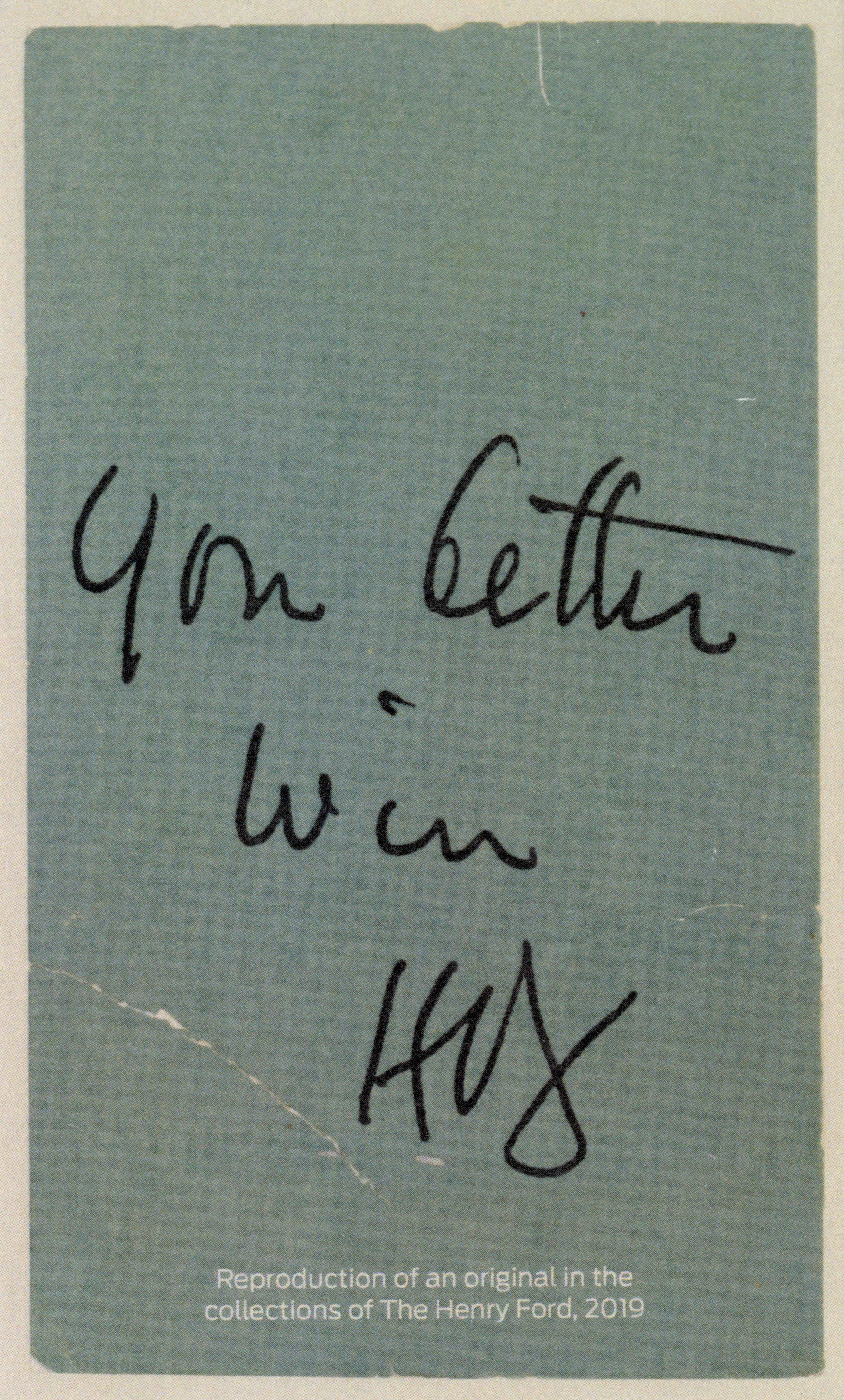
"You better win." — Henry Ford II, June 1966, as recounted in A.J. Baime's Go Like Hell
It is just past four o'clock on a gray Sunday afternoon in June 1966, and the rain is pounding on the Circuit de la Sarthe. Eight and one-third miles of French country road, closed for the weekend and slick as a bar top, running out past the cafés and the pine woods and the little farms where families have set up chairs at the fence line the way their parents did and their grandparents before them.
Three hundred thousand people are out there in soggy blankets and muddy slopes. They have been there all night. They have watched the headlights of race cars rocket in a blur through the darkness, heard the engines rise in a crescendo and then fade. Fifty-five cars started this race twenty-four hours ago. Fifteen are still running.


And now, out of the murk at the end of the pit straight, come three of them. Running in formation — one, two, three, close enough to share a lane — painted in the colors of an American car company that four years earlier had never won a road race in Europe. Never seriously entered one. The cars are Ford GT40 Mk IIs, low as a coffee table, brutal as a bank vault, each one carrying a 427-cubic-inch V8 lifted more or less out of a NASCAR stock car and taught some manners.
They are about to cross a finish line that Enzo Ferrari had owned for the better part of a decade — six straight wins, 1960 through 1965, an empire of red cars and black armbands — and they are about to take it away from him in the most public manner imaginable.
To understand what that moment cost — and to understand how this race is guiding the stories we’re going to be telling on this website — we have to go back three years, to a negotiation that curdled into a feud.
The Feud
In the spring of 1963, Ford Motor Company tried to buy Ferrari. It made a certain kind of sense on paper. Ford had money; Ferrari was penniless, but well-dressed. The Deuce — Henry Ford II, grandson of the founder, a man with an appetite for winning who had pulled the company back from the brink after the war — wanted into European racing, and Enzo Ferrari, so utterly obsessed with racing he built road cars solely to fund his efforts on the track, needed capital. Ford sent lawyers and accountants to Italy and did a thorough audit. It was close enough to draft documents.
And then Enzo read the fine print — the clause that would have given Dearborn final say over his racing program, his budget, his entries, his sport — and he blew the whole thing up across the table, with language the interpreters reportedly softened out of decency. He insulted the company, and by most accounts, he insulted the Deuce personally.
The men from Ford flew home empty-handed, and when the report reached the top floor of the Glass House in Dearborn, Henry Ford II issued the order that set the whole improbable machine in motion: If Ford couldn't buy Ferrari, Ford would beat Ferrari — at Le Mans, the one race that mattered most to the old man, the one stage where the whole world was watching. Price was not among the listed considerations.

What followed was one of the great industrial crusades of the twentieth century, and for two years it was a fiasco. The first GT40s were beautiful and fast and fragile as stemware. Le Mans 1964: three cars entered, none finished. Le Mans 1965: six cars entered — Ferrari-beating speed, headline-making pace — and by the middle of the night, every single one of them was dead by the side of the road, gearboxes and head gaskets scattered across the French countryside, while Ferrari swept the podium yet again.
The program burned money in quantities that made the accountants physically ill. Careers were staked and lost. The Deuce, humiliated twice on the world stage, responded not by retreating but by escalating — more money, more cars, more engine, and a piece of executive communication ahead of the '66 campaign that survives in company legend for its brevity. Three words, and every man in the program understood them completely: You better win.
To most of the racing public, the men charged with delivering on those words were a strange and combustible pair of Southern California hot-rodders. Carroll Shelby, the chicken farmer from East Texas with the striped bib overalls and the borrowed-money grin, who had won this very race for Aston Martin in 1959 with nitroglycerin pills taped under his dashboard for a heart condition that would eventually force him out of the cockpit and into the pit box. And Ken Miles, Shelby's development driver and something of a resident genius — a lean, sharp-beaked, sharp-tongued Englishman who’d been a tank commander in Normandy before he ended up a test driver in Los Angeles.
Of course, just as Neil Armstrong and Buzz Aldrin were two of hundreds of crucial members of NASA’s Apollo moon landing, Shelby and Miles were buoyed to Le Mans by an extraordinary collection of brilliant engineers, as well as the Holman-Moody team out of Charlotte, and England’s Alan Mann Racing.
These engineers worked with Miles to refine the Mk II. It began as an unfinished brute, and Miles drove it and broke it and the team rebuilt it, and he drove it again — at Daytona, at Sebring, at the Ford test tracks. Eventually, it was the fastest endurance racing car on Earth. Down the Mulsanne Straight in the June darkness it would touch 210 miles an hour, a speed no man had ever reached on that road, the whole car shuddering at the edge of what adhesion and physics would permit.
In 1966, Ford came back to France with a fleet. Eight GT40 Mk IIs on the entry list — three from Shelby American, three from Holman-Moody, two from Alan Mann Racing — backed by that armada of engineers, and corporate resolve unlike anything the old European sport had ever seen. Ferrari arrived with his lovely red P3s and the heady momentum of six straight victories.


During the race, it rained. Cars shunted and burned and broke throughout the night, the attrition taking Fords and Ferraris alike. But by Sunday morning, Enzos cars had receded, and the race belonged to Dearborn. The only remaining question was which Ford would win it — and the answer to that question became one of the sport's enduring heartbreaks.
Miles, who had already won Daytona and Sebring that year, was in the lead car. A sweep of the three great endurance races in a single season — a feat no driver had ever accomplished — was just an hour away. And someone in the Ford camp, thinking of photographs and history, ordered the leading cars to slow and cross the line together. A dead heat, staged for the cameras. Initially the French race organizers gave the go ahead for the plan, but changed their minds in the final minutes: the second-place car of Bruce McLaren and Chris Amon had started a few dozen yards further back on the grid, had therefore covered a marginally greater distance, and was therefore — by arithmetic, not by racing — the winner.
Ken Miles, a key member of the Le Mans program who would become a towering figure in racing history, was placed second in a photo finish he had been ordered into. He shook it off in public, the way racers of that generation did. Two months later, testing the next iteration of the car at Riverside, he was killed when it crashed and came apart. He was forty-seven. The photograph of the three cars crossing the line abreast in the spray became one of the indelible images of the twentieth century, and it has a hole in the middle of it that racing people can see from across the room.

Ford won Le Mans again in '67 with an all-American crew, and again in '68, and again in '69. Enzo Ferrari wouldn’t live to see another victory. The Deuce got his revenge in full. But 1966 is the race that kicked off the modern era — the money, the vendetta, the rain, the jumbled podium. It has all the ingredients of a great American story, including the part where the victory costs more than anyone agreed to pay.
The Reunion
This past July, on a green hillside in West Sussex, England, the story physically reassembled itself.
The Goodwood Festival of Speed is the world's great garden party of speed — roughly 300,000 people over a long weekend on the Duke of Richmond's estate, watching a century and a quarter of racing machinery run up a narrow ribbon of driveway past the front door of the house. This year's theme was the sport's great rivalries, and no rivalry in the history of motor racing looms larger than Ford versus Ferrari. So Goodwood did the thing that everyone assumed could not be done: It gathered, in one place, the three actual cars from that gray afternoon at La Sarthe.
Not replicas. Not continuation cars or tribute liveries. The cars. Chassis P/1046, the black McLaren/Amon car that took the win. P/1015, the light blue car Miles and Denny Hulme brought home second by a rulebook and a grid slot. P/1016, the bronze Holman-Moody entry of Ronnie Bucknum and Dick Hutcherson that completed the sweep. Held today by devoted private custodians, the three had not run together in public in a decade — by some accountings, they had not run in formation since the 1960s.

And then they did. Up the Goodwood Hill, three abreast where the road allowed, 427s bellowing off the Sussex flint walls, on Goodyear rubber just as in '66, with members of the Shelby family watching from the paddock. Grown adults who own modern hypercars stood in the crowd and went quiet. In September the three cars meet again at the Goodwood Revival, where they will run the historic circuit together and — this is the plan — line up in front of the pits to recreate the photograph. Sixty years on, people cross oceans and spend fortunes to stand in the rain and listen to these machines run.
That's worth sitting with for a moment. Because it tells you something that the spreadsheet people, in every era and every industry, keep forgetting: a car company is not, at bottom, a maker of transportation appliances. It is a keeper of stories. The machines are the artifacts; the stories are the product. And Ford has been telling its story, in print, longer than almost anyone — in one publication above all.
A View of America Through the Windshield
On April 15, 1908 — five months before the first Model T left the Piquette Avenue plant — Ford Motor Company published the first issue of Ford Times. Consider the timing. There was no assembly line yet. No five-dollar day. No numbered highways, no road maps worth the name, no roadside America — no diners, no motels, no filling stations, because there was nothing yet to fill. The American road as we understand it did not exist.

The magazine came first. It was a modest thing in those years, a few inches of trim size, written mainly for the dealer network: sales notes, mechanical tips, company news, the occasional flight of boosterism. But it was present at the creation, and when the country began paving itself — which it did, mile by mile, largely because of the car whose company printed this magazine — Ford Times was already in the glovebox, so to speak, waiting.
The magazine went quiet in April 1917, when America entered the First World War and paper and attention went to other purposes. It stayed quiet for a generation — through the boom, the Crash, the Depression, the second war. Then in 1943, with Henry Ford II about to take command of his grandfather's foundering company and remake it, Ford Times came back — and after the war it became something genuinely new: a digest-sized monthly, five inches by seven, sixty-four pages, mailed free to Ford owners by their dealers, with a mission its editors put in a single phrase that has never been improved upon: a view of America through the windshield.
For the next 50 years, Ford Times was the great glovebox companion of the American century — a pocket-sized argument that the country was worth going to see. It told you where to drive: the covered bridges of Vermont, the missions of California, the lesser-travelled highways that only locals know about. It told you where to fish and where to camp and which state fairs were worth the detour.


And in its most beloved recurring feature — "Favorite Recipes from Famous Restaurants" — it told you where to eat when you got there, then printed the recipe so you could take the meal home with you, an act of hospitality so durable that the collected Ford Times Cookbook still trades hands today, and so does the argument about whose hot brown or she-crab soup deserved the ink.
The bylines, for a free promotional monthly, were preposterous. William Faulkner wrote for Ford Times. So did John Steinbeck, E.B. White, Ogden Nash, Erle Stanley Gardner. The magazine paid real money, respected its readers, and operated on the radical premise that people who bought inexpensive cars deserved expensive prose.
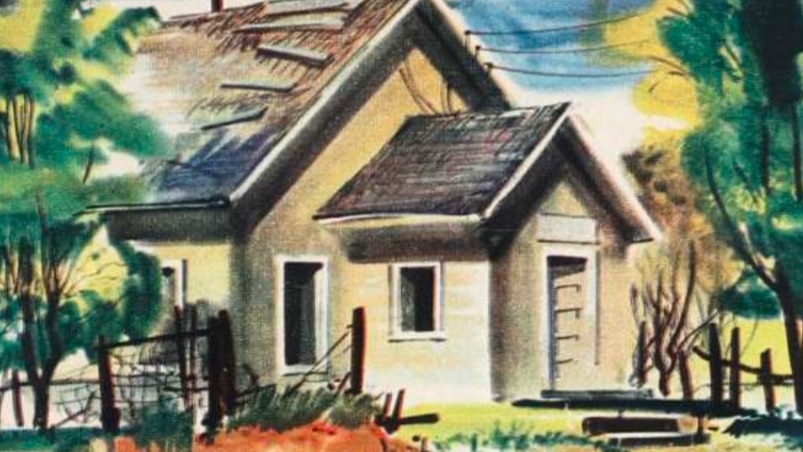
And then there was the art. Arthur Townsend Lougee was 32 years old when he joined the staff 1946, and served as its Art director and Executive Editor until 1961. Under his leadership, Ford Times transformed from a dealership handout into a patron of American art. He commissioned regional painters — most famously Charley Harper — and published a collection of 7,000 works by nearly 700 artists. The glovebox giveaway slowly transformed into a publishing design landmark. Harper credited the magazine with shaping his own distinctive style, which now hangs in museums.
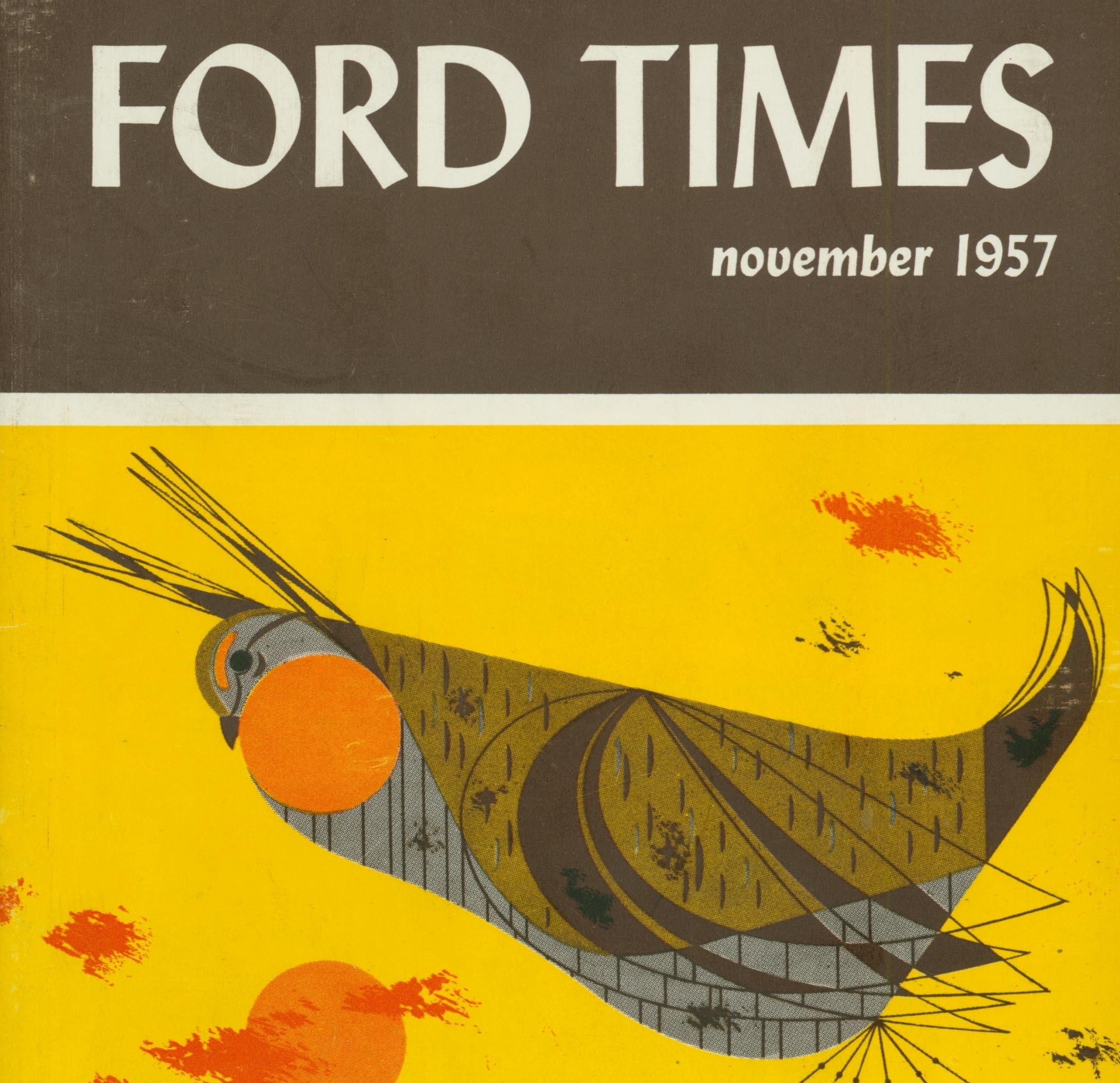
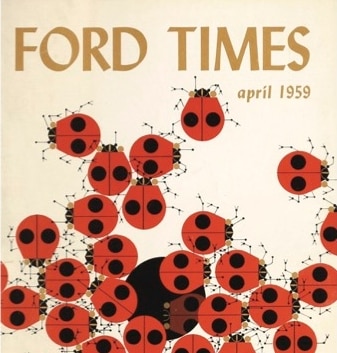
The history of this magazine makes its own case for what a company publication can be when it aims high.
At its peak in the 1950s and '60s, Ford Times reached nearly two million households a month — circulation in the neighborhood of Time — while remaining small enough to fit in a shirt pocket, which was precisely the point. It rode along on the great postwar road trip: the interstates unspooling, the station wagons loading, the two-week summer vacation as a national institution. It was corporate media, yes — nobody pretended otherwise — but it was corporate media that believed its highest duty was to be useful and beautiful, in that order, and it kept the faith for half a century. The company handed the magazine to outside publishers in 1987, and in January 1993, in a season of cost-cutting, the last issue went out to the faithful.
The road, of course, kept going.
The New Chapter
The assignment isn't finished. Now, it’s coming back at Ford From the Road. The founding premise of Ford Times — that the truest way to understand America is to drive through it — is as sound in 2026 as it was in 1946, and arguably sounder in the social media age, when people often see the country through social media posts passed along by people who’ve never actually made the journey.
That’s why we’re hitting the same two-lane blacktop that still runs through the towns the interstate forgot, past the water towers with high-school mascots painted on the side. The diner with the recipe worth stealing still exists, though today it might be a taqueria in a converted Sinclair station, a Hmong sausage counter at a Minnesota farmers' market, or a barbecue trailer in the Hill Country with a four-hour line and no chairs. The state fairs still run. The roadside attractions have gotten stranger, which is to say better. The impulse is unchanged and apparently unkillable: get in the car, go see it, come back and tell everybody.
What's changed is nearly everything else, and that's the story too. The car that carries you down that two-lane might make no sound at all. It might park itself, update itself overnight while it charges in the driveway, watch the road with a dozen unblinking eyes and reflexes no human ever had. The trip you once plotted with a folding map, a full ashtray, and an argument now assembles itself on a screen before you finish your coffee. The filling station is becoming something else — a charging plaza, a ghost, a taqueria. Whole towns that lived on the highway are figuring out their second acts, and some of them are magnificent.
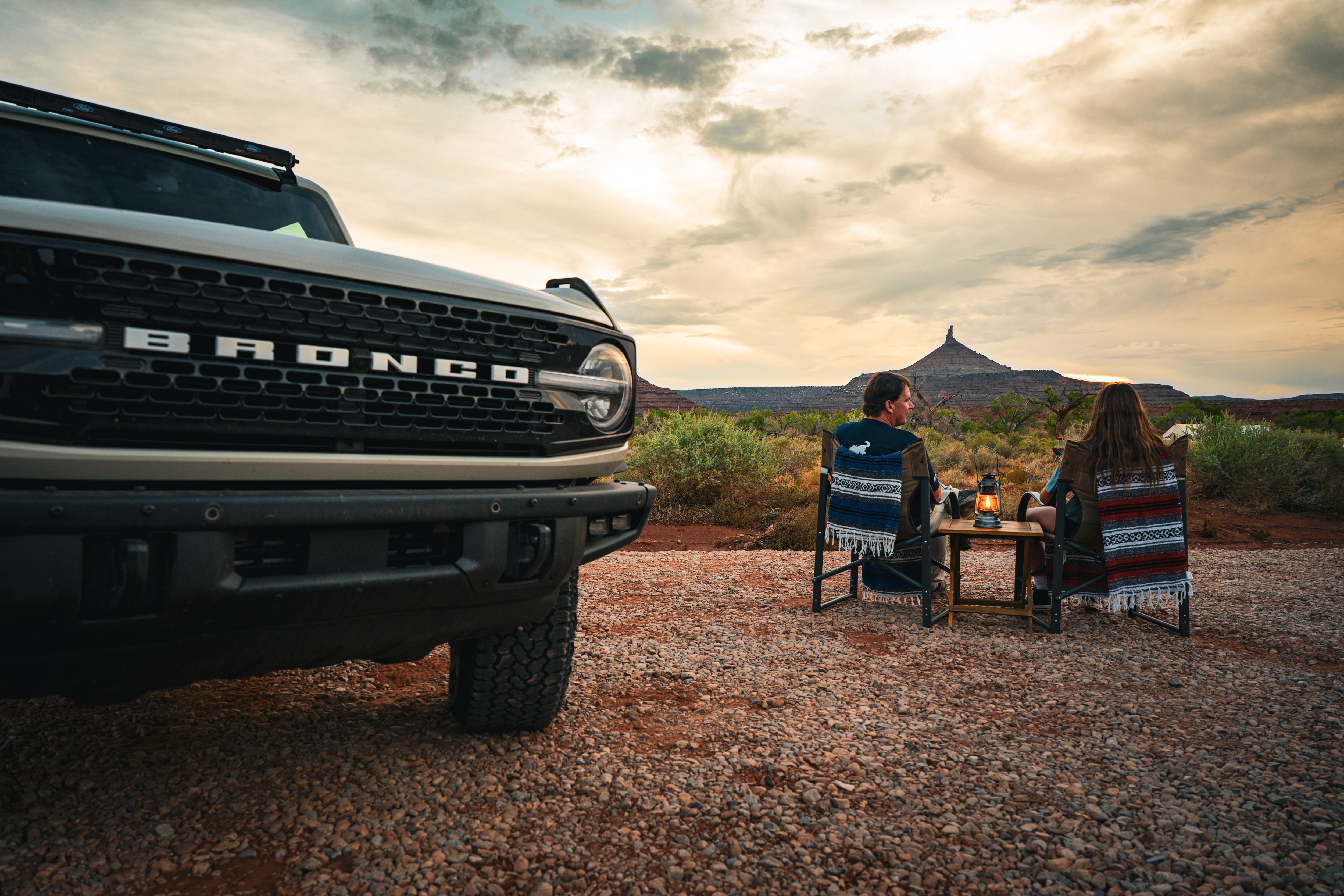
The great American road trip has survived every transformation thrown at it — the interstates that bypassed Main Street, the oil shocks that emptied the pumps, the minivan, the airline deregulation that put the family of four at 35,000 feet, the phone that promised you'd never need to wonder where anything was again. It absorbed all of it and kept going, because the road answers a question the screen cannot: what is it actually like out there? That question is our beat.
Ford From the Road is launching a travelogue series that picks up where Ford Times left off, with the same brief and a wider lens. We'll bring you the country: the drives and the detours, the food and the people who cook it, the small towns reinventing themselves and the big cities you only think you know, the American road in all its persistence and reinvention. We'll bring you the machines — where they've been and where they're going, from a 427 thundering up an English hillside on sixty-year-old glory to whatever is coming next out of Dearborn that would have made the Deuce's cigar fall out of his mouth.
We'll bring back the old magazine's founding faith, the thing Harper's covers and the recipe pages and the Faulkner bylines all understood: that a publication, like a good car, should be a well-made thing that takes you somewhere — and that the people it's made for deserve the best work you can do.
Sixty years ago at Le Mans, in the rain, Ford proved it could go anywhere and beat anyone, and the world is still gathering on hillsides to celebrate it. For most of a century before and after, Ford Times proved something quieter and maybe more durable: that the going itself — the road, the country, the story you bring home — was the whole point.
Welcome back. The tank is full. Let's go.
Never Miss a Story
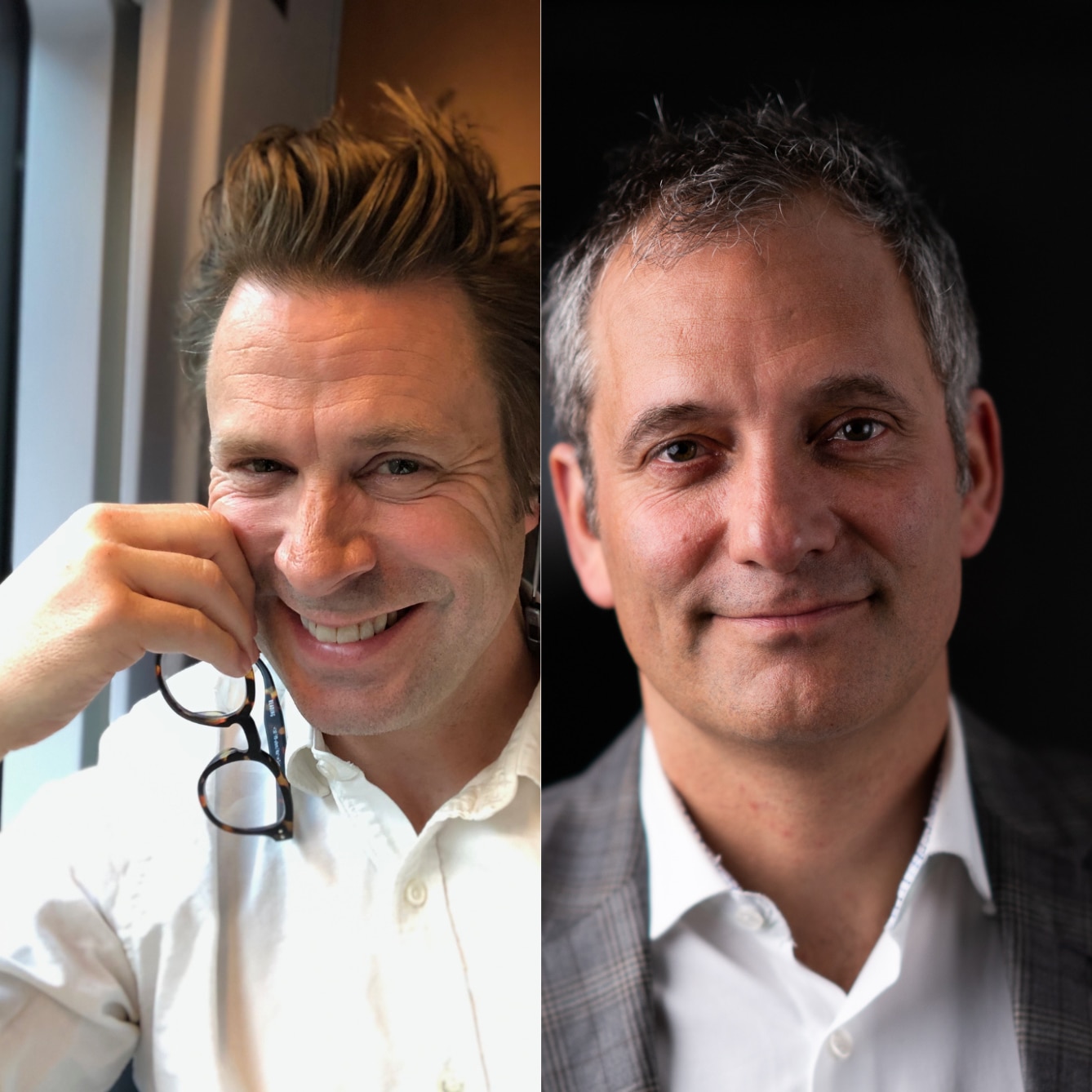
Mike Guy, the former editor-in-chief of Road & Track, is the editorial director of the travelogue series. A.J. Baime is the author of Go Like Hell: Ford, Ferrari, and Their Battle for Speed and Glory at Le Mans, and The Arsenal of Democracy.