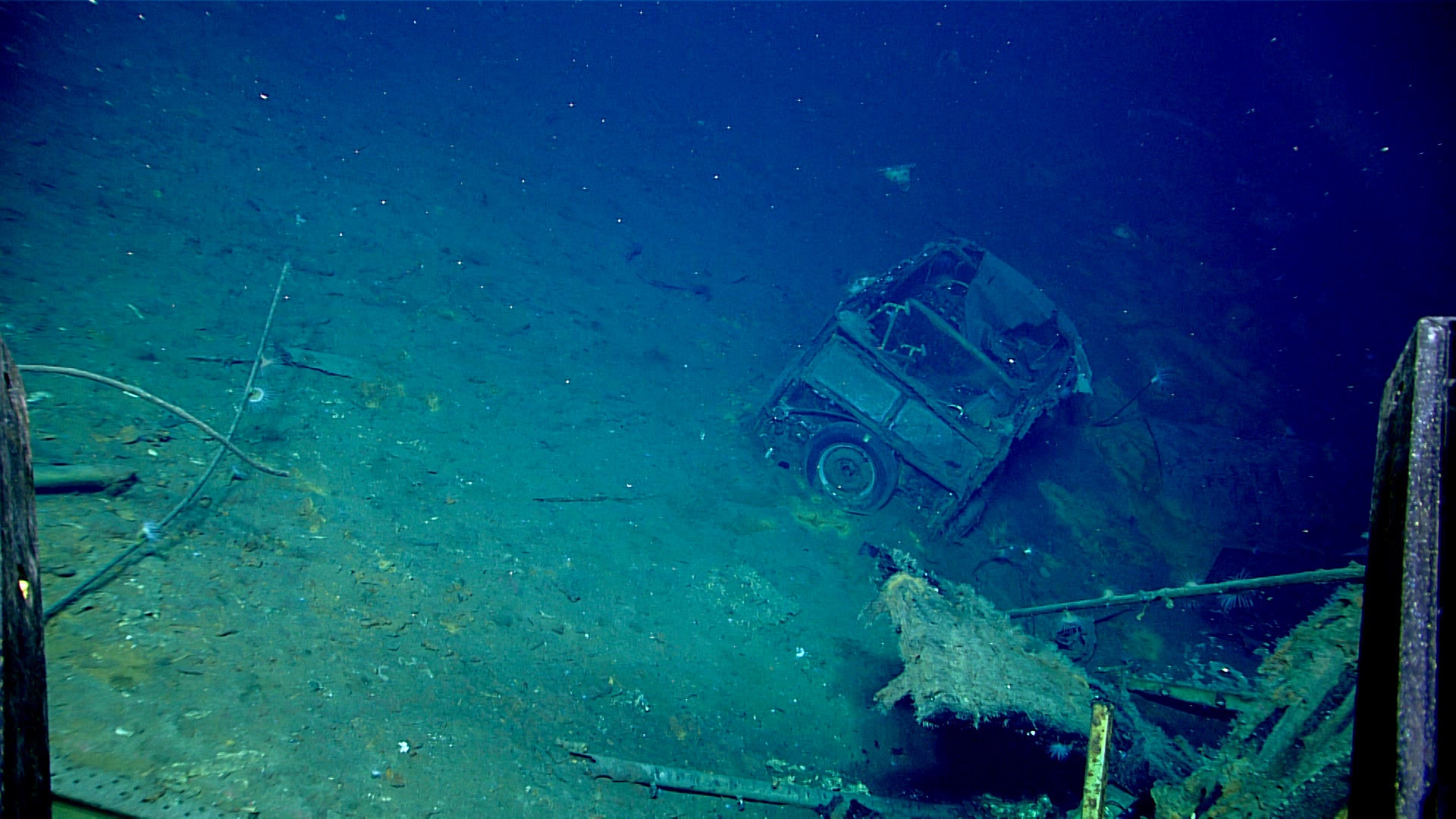

A 1941 Ford Super Deluxe Woody spent 83 years hidden inside a sunken aircraft carrier at the bottom of the Pacific Ocean. When the cameras on NOAA’s remotely operated vehicle (ROV) Deep Discoverer first imaged it on April 19, 2025, the world stopped scrolling.
The last thing the marine archaeologists expected to find three-and-a-quarter miles under the sea was a set of chrome hubcaps.
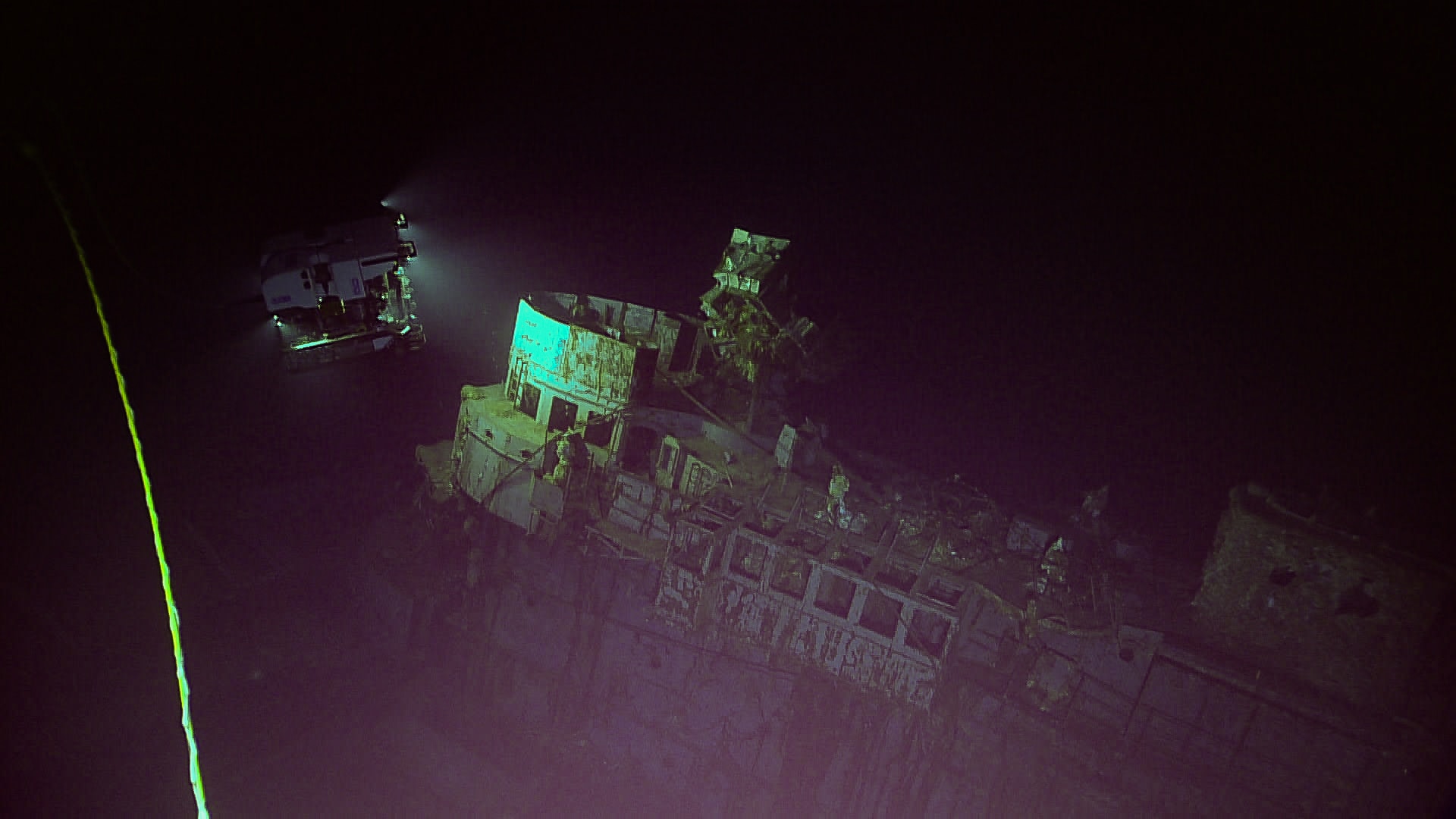
Sam Cuellar had the best seat onboard NOAA Ship Okeanos Explorer. He was watching a high-definition video feed from ROV Deep Discoverer as it hovered near the port-side hangar bay of USS Yorktown, a Naval aircraft carrier sunk during World War II’s Battle of Midway in June 1942.
When the team peered through a large bay door, two round, shiny objects glinted onscreen, sitting off in the murk on the opposite side of the ship.
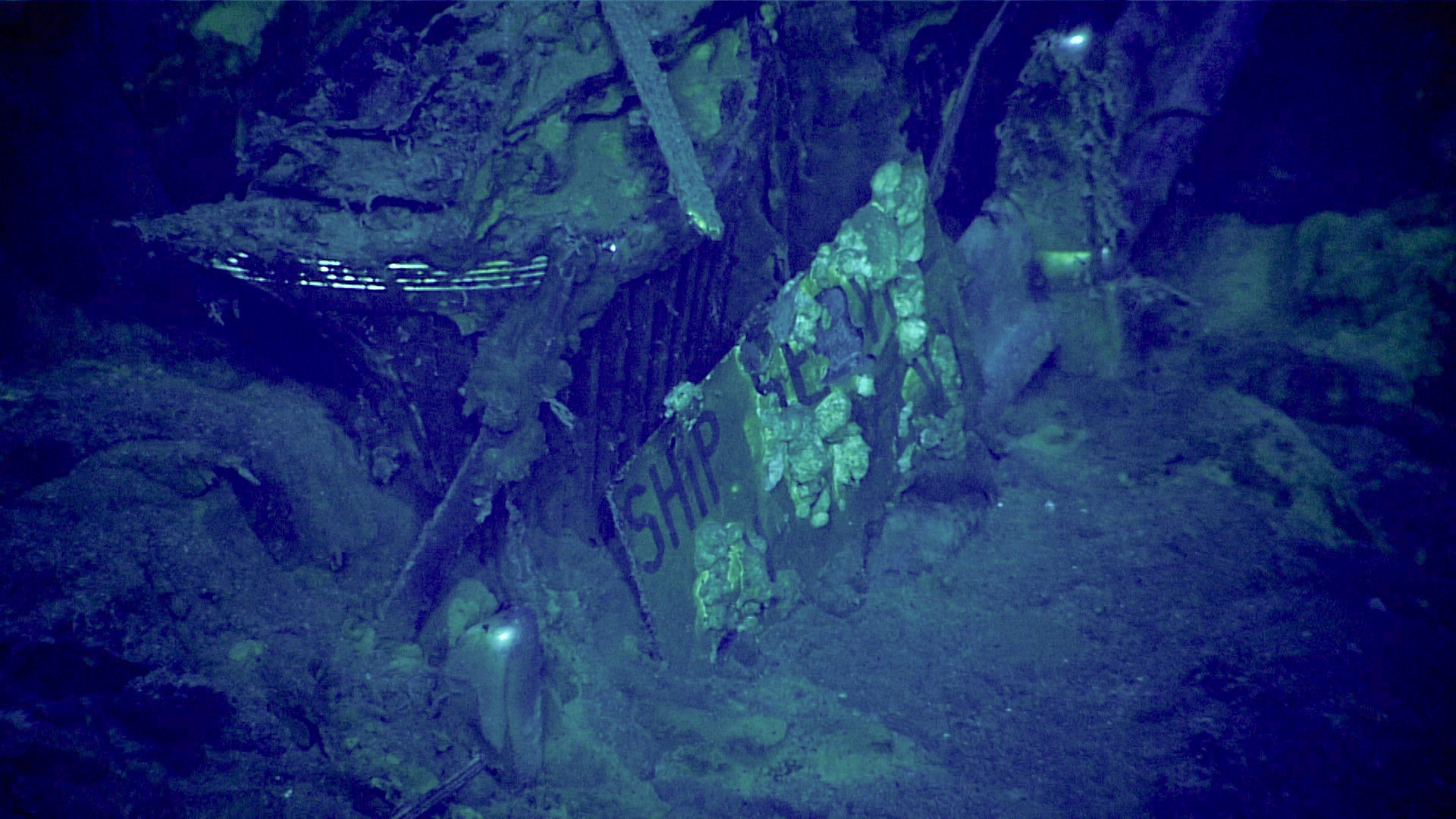
"We couldn't quite make out what it was at first,” recalled Cuellar, who served as expedition coordinator for NOAA Ocean Exploration. “As we zoomed in, you could slowly start seeing the outline of a vehicle shape and what appeared to be white-walled tires.”
“And then it clicked. Is that a car?!"
The moment the submerged vehicle — which sported a handmade license plate reading "SHIP SERVICE ___ NAVY” — popped up near the end of the five-hour dive on the live feed, which had thousands of viewers, the expedition’s chat room erupted. NOAA put out a call for auto enthusiasts to help ID the mystery car.
Ford Archivist Ted Ryan’s phone started buzzing with messages from colleagues and friends, who’d seen the story on the news.
“I sent it to my team, and we pretty quickly verified it was a Ford Woody because of the spare tire on the back and the rectangular rear windows,” said Ryan, who grabbed a model Woody off his office shelf and shot a quick video for Ford’s social media handles. The clip went viral within hours.

USS Yorktown held personal significance for Ryan, who’d written about the Battle of Midway nearly 50 years ago as a sixth-grader in Atlanta.
“That school paper, which I still have, made me realize I wanted to do history for a living,” he said. “It’s been amazing to see this story come full circle. The anomaly of finding a Ford automobile on deck is what everyone will remember.”
The features that gave it away — which also include chrome fender detail, a split windshield, parking lights above the headlights, and a chrome bumper — are the same hallmarks Ford enthusiasts have celebrated for decades. Marine archaeologists are also well-versed in what rotting wood looks like underwater; just enough of the Woody's signature wood paneling was visible to make the case. Reddit threads and car aficionados coalesced on the same answer, almost simultaneously.
Ford began mass production of the Woody in 1929, sourcing old-growth timber from Michigan’s Upper Peninsula for the model’s signature paneling. As the U.S. entered World War II, Ford retooled its factories for defense-related production and by February 1942, ceased production of civilian automobiles altogether.
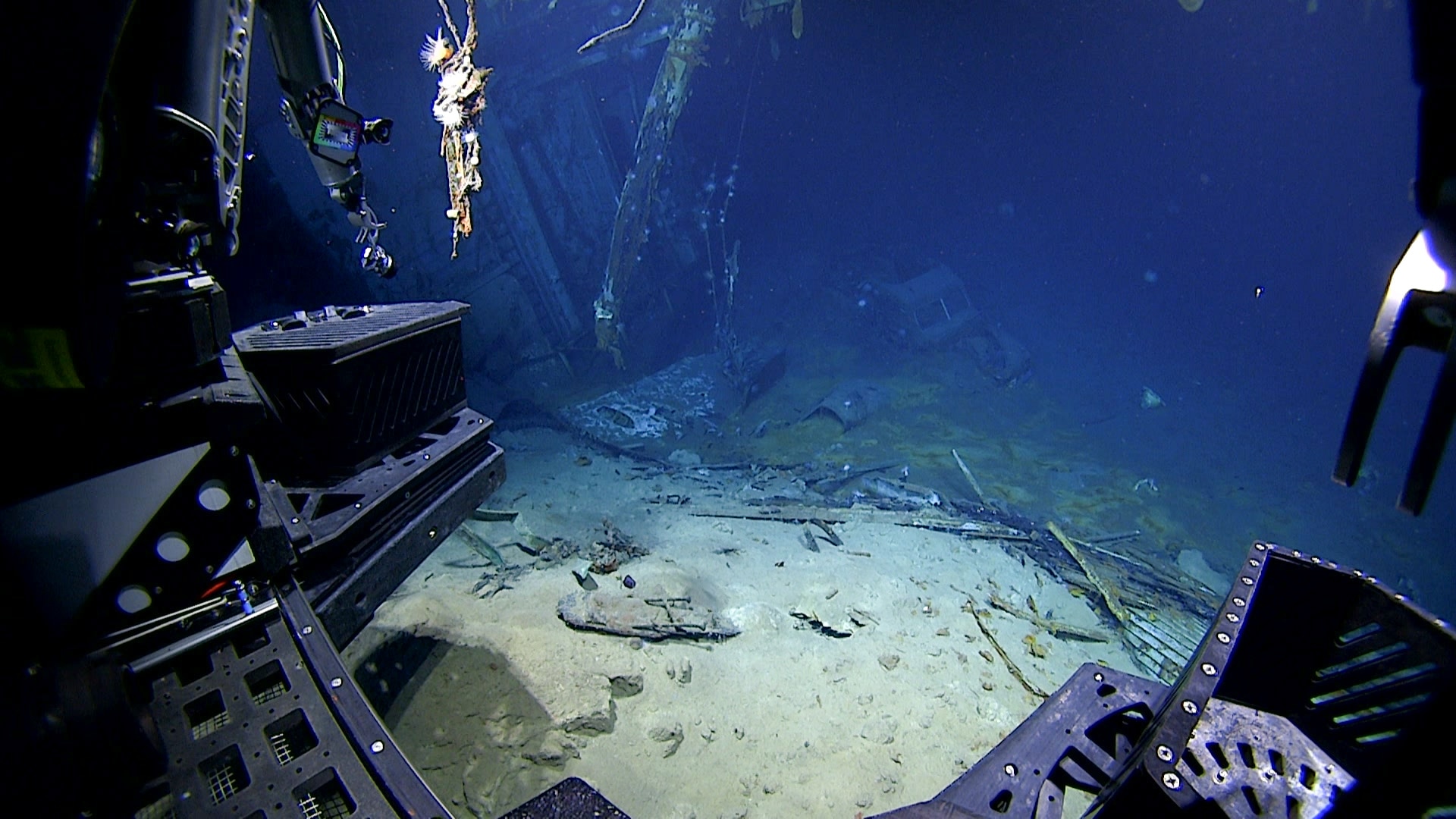

The Woody's versatility — well-suited for hauling supplies, ferrying officers, running ship errands for the ship and crew — made it the ideal utilitarian vehicle for a warship traveling the world.
Questions multiplied as fast as the answers. Why was a civilian automobile — not a military C-11 version of the Woody, which was produced in Canada — aboard one of the most consequential warships in American history?
The leading theory, backed by National Archives Foundation research, is that the Woody belonged to the Pearl Harbor Naval Shipyard and was likely driven aboard when the ship was dry-docked for a hasty, three-day repair after sustaining damage in the Battle of the Coral Sea. USS Yorktown was torpedoed by aerial bombers and ultimately sunk by Japanese submarine I-168.
Footage also surfaced of a nearly identical Ford Woody sitting proudly on the deck of USS Lexington, filmed in 1941 by director John Ford — whose studio was one of the world's largest film producers at the time and donated its footage to the National Archives. Two Woodies. Two aircraft carriers. The same era. The same model.
“The Woody is an absolute gem of a find that can reframe how the discipline looks at automotive archaeology and explores the roles cars played on warships”Phil Hartmeyer, lead marine archaeologist for NOAA Ocean Exploration
The 2025 dives to the Yorktown’s final resting place yielded other remarkable finds, including the first-ever images of a 42-by-12-foot hand-painted mural inside the No. 2 elevator shaft, and the identification of several Douglas SBD Dauntless dive bombers still in the hangar deck, one of them inverted with a 500-pound bomb still secured in its release cradle.
Technological advancements and telepresence-enabled exploration enabled the team of archaeologists to build on findings from 1998 and 2023 Yorktown expeditions.
“We wanted to better understand what damage may have caused Yorktown to sink by exploring areas we hadn’t been able to get to before,” said Phil Hartmeyer, lead marine archaeologist for NOAA Ocean Exploration. “We are creating a three-dimensional photogrammetric model of the wreck site, which entails stitching together thousands of high-resolution images into an immersive snapshot.”

Hartmeyer calls the Woody discovery a “chapter of automotive history we were not expecting.” NOAA is exploring the possibility of returning this spring to a collection of automobiles disposed of after the attack on Pearl Harbor.
“Archaeology has the ability to showcase parts of our human past, including our connection with the water, that come in really unexpected, surprising ways,” he added. “The Woody is an absolute gem of a find that can reframe how the discipline looks at automotive archaeology and explores the roles cars played on warships.”
For Ford, it's a story that cuts to the core of what made the company's vehicles legendary: built rugged enough to work anywhere, adaptable enough to serve anyone, and durable enough — apparently — to endure 83 years on the ocean floor. The 1941 Super Deluxe Woody now sits in the dark, 5,200 meters deep, its chrome still catching the light of a remotely operated vehicle, its wood still faintly present, its story still unfolding.
Jay Moye is an Asheville, North Carolina-based writer, editor and musician.